What Is FTL (Full Truck Load)? A Complete Guide for Indian Businesses
If you’ve ever shipped a large consignment from Mumbai to Delhi — and watched it arrive late, damaged, or mixed up with someone else’s cargo — you already understand why the right freight model matters. For businesses moving high volumes of goods across India, FTL (Full Truck Load) is often the most efficient, secure, and cost-effective solution available.
But what exactly is FTL, how does it work, and when should your business choose it over other freight options? In this guide, we break down everything you need to know about Full Truck Load transport — from how it’s priced to how it compares with PTL, and how to find a reliable FTL partner for PAN India deliveries. Whether you’re a manufacturer in Pune, a retailer in Ahmedabad, or a supply chain manager sourcing goods across 20 states, this article is for you.
What Is FTL (Full Truck Load)?
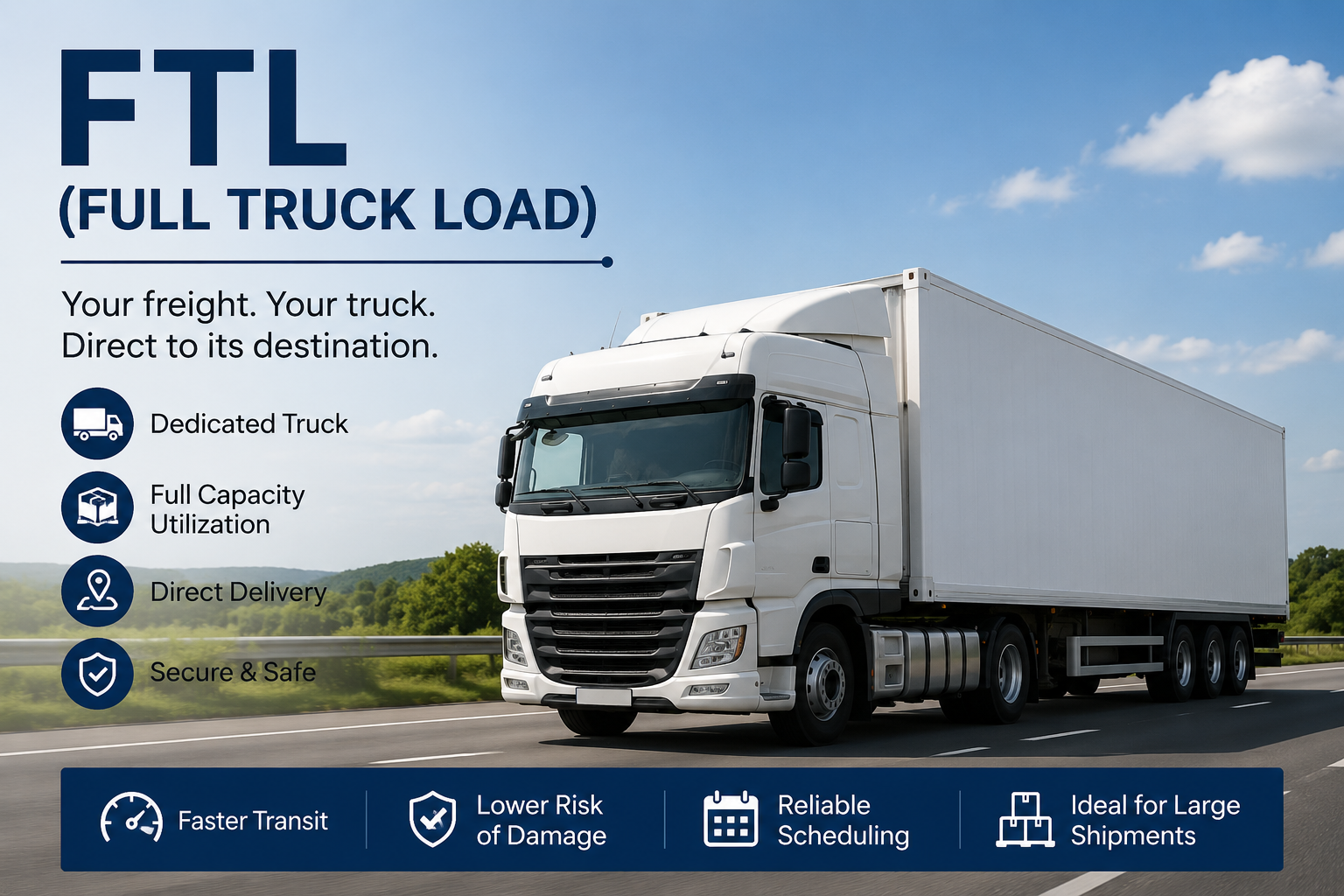
FTL, or Full Truck Load, is a freight shipping model where a single shipper books an entire truck exclusively for their cargo. Unlike shared freight models, the truck carries only your goods — from the point of origin directly to the destination.
This means:
- No co-loading — your goods don’t share space with another company’s shipment
- Direct routing — fewer stops, faster delivery
- Dedicated handling — reduced risk of damage or misplacement
FTL is ideal when your shipment is large enough to fill most or all of a standard truck’s capacity. In India, trucks typically range from small 1-tonne tempos to large 40-feet trailers capable of carrying 20–25 tonnes or more.
How Does FTL Work?
The FTL process is straightforward:
- Booking — You contact a transporter and specify your cargo volume, type, origin, and destination.
- Truck Assignment — A dedicated truck is allocated solely for your consignment.
- Loading — Your goods are loaded at the pickup point.
- Transit — The truck travels directly to the destination with no intermediate stops.
- Delivery — Cargo is unloaded and handed over at the delivery point.
With a reliable logistics partner, you also get real-time GPS tracking throughout the journey — giving you full visibility at every stage.
When Should Your Business Choose FTL Transport?
FTL is not the right choice for every shipment. However, it becomes the clear winner in several common Indian business scenarios:
Signs Your Shipment Needs FTL
- Your cargo weighs more than 10 tonnes or fills over 70–80% of a truck
- You’re shipping fragile, high-value, or time-sensitive goods that can’t risk co-loading
- You need direct, non-stop delivery between two cities
- Your goods are hazardous or regulated and require dedicated handling
- You’re shipping bulk commodities — steel coils, chemicals, FMCG products, auto parts, or industrial equipment
- You want predictable transit times for supply chain planning
For example, a textile manufacturer in Surat shipping finished fabric to retail warehouses in Bengaluru will almost always benefit from FTL — faster transit, no damage risk from mixed loading, and predictable delivery windows for the retailer’s inventory planning.
FTL vs PTL — What’s the Difference?
One of the most common questions in Indian logistics is: FTL or PTL? Here’s a clear comparison:
| Feature | FTL (Full Truck Load) | PTL (Part Truck Load) |
|---|---|---|
| Truck Usage | Entire truck for one shipper | Truck shared by multiple shippers |
| Cost | Higher per trip, lower per kg | Lower per trip, higher per kg |
| Transit Time | Faster — direct routing | Slower — multiple stops |
| Risk of Damage | Lower — no co-loading | Higher — multiple handlings |
| Best For | Large, bulk, or sensitive cargo | Small or irregular shipments |
| Delivery Predictability | High | Moderate |
The rule of thumb: If your cargo fills more than two-thirds of a truck, FTL almost always works out cheaper and safer than PTL. For smaller, ad-hoc shipments, PTL may make more economic sense.
Understanding this distinction helps businesses allocate freight budgets smarter and avoid paying for convenience they don’t need — or cutting corners on cargo safety.
Key Benefits of FTL for Indian Businesses
Full Truck Load transport offers distinct advantages that directly impact your business’s bottom line and operational efficiency:
1. Faster Transit Times
Because an FTL truck travels directly from origin to destination without co-loading stops, delivery is significantly faster. For time-sensitive industries — pharmaceuticals, perishables, e-commerce — this speed advantage is critical.
2. Lower Risk of Cargo Damage
When goods travel in a dedicated truck with no other consignments, the risk of damage, misplacement, or contamination drops sharply. This is especially important for electronics, glassware, machinery parts, and other fragile products.
3. Cost Efficiency at Scale
While FTL appears expensive upfront, it typically delivers a lower cost per kilogram for large shipments. When you factor in reduced damage claims, faster inventory turnover, and fewer transit delays, the ROI becomes clear.
4. Greater Visibility and Control
Leading FTL providers offer GPS-based real-time tracking. You know exactly where your consignment is at every point — a major advantage for supply chain managers coordinating deliveries across multiple locations.
5. Suitable for ODC and Specialised Cargo
For Over Dimensional Cargo (ODC) — large machinery, construction equipment, wind turbine parts — FTL is often the only viable option. Dedicated trucks can be configured for specific cargo requirements.
Why Choose Superior Transways for FTL Transport in India?
When it comes to reliable Full Truck Load transport across India, Superior Transways stands out for businesses that cannot afford delays, damage, or uncertainty.
Headquartered in Vasai, Mumbai, Superior Transways has been a trusted name in Indian logistics for 15+ years, serving 4,000+ business clients across industries including manufacturing, retail, FMCG, pharmaceuticals, and automotive.
Here’s what sets them apart:
- PAN India Network — Operations across 25+ states, covering major industrial corridors from Mumbai–Delhi to Chennai–Kolkata
- Diverse Fleet — From small tempos to 40-feet trailers, with capacity for FTL, ODC, and bulk transportation
- Real-Time GPS Tracking — Full visibility of your consignment throughout transit
- 24/7 Customer Support — Dedicated support teams available round the clock for updates, escalations, and coordination
- Safe Cargo Handling — Trained loading teams, proper lashing, and transit insurance options to protect your goods
- Experienced Team — 15+ years of operational expertise means fewer surprises and smarter routing
Whether you need a single FTL trip from Mumbai to Hyderabad or a regular freight contract across multiple states, Superior Transways delivers with consistency and accountability.
👉 Explore our FTL Transport Services → 👉 View all Logistics Solutions →
Frequently Asked Questions About FTL
What does FTL mean in logistics?
FTL stands for Full Truck Load. It refers to a freight model where one shipper books an entire truck exclusively for their cargo. Because the truck isn’t shared, goods travel directly from origin to destination with fewer handling points, lower damage risk, and faster delivery times. It’s the preferred model for large, bulk, or high-value shipments in India.
What is the minimum weight for FTL booking?
There is no strict universal minimum for FTL in India, but it becomes cost-effective when your shipment exceeds 8–10 tonnes or occupies more than 70% of the truck’s capacity. For smaller loads, Part Truck Load (PTL) or groupage services may be more economical. A logistics provider can assess the best option based on your cargo volume and route.
How is FTL pricing calculated in India?
FTL pricing in India typically depends on: truck type and size, distance between origin and destination, nature of cargo (general, hazardous, ODC), and current fuel rates. Most transporters charge on a per-trip or per-tonne-per-km basis. Larger contracts with regular volumes often attract negotiated rates. Always request a detailed quote that includes all applicable charges.
Is FTL better than PTL for bulk freight transport?
Yes, for bulk freight transport, FTL is usually the better option. It offers direct routing, faster delivery, and lower per-kg cost at scale. PTL makes more sense for smaller, irregular shipments that don’t fill a full truck. If you regularly ship large volumes on fixed lanes — such as factory-to-warehouse or warehouse-to-retail — FTL is more efficient both operationally and financially.
Can FTL trucks handle ODC (Over Dimensional Cargo)?
Yes. Specialised FTL trucks can be configured for ODC transportation — including open flatbed trailers, multi-axle vehicles, and low-bed trucks — to handle heavy machinery, construction equipment, wind blades, and other oversized loads. These shipments require route surveys, escort vehicles, and regulatory permits, which experienced logistics providers like Superior Transways manage end-to-end.
Conclusion
FTL (Full Truck Load) is one of the most powerful freight tools available to Indian businesses — offering speed, security, and cost efficiency for large consignments moving across the country. Whether you’re shipping industrial goods from Gujarat, FMCG products from Maharashtra, or machinery to the Northeast, choosing the right FTL partner makes all the difference.
Superior Transways brings 15+ years of experience, a PAN India network across 25+ states, and a commitment to safe, on-time delivery to every shipment. With 4,000+ satisfied clients and round-the-clock support, we’re ready to handle your freight requirements — no matter how complex.