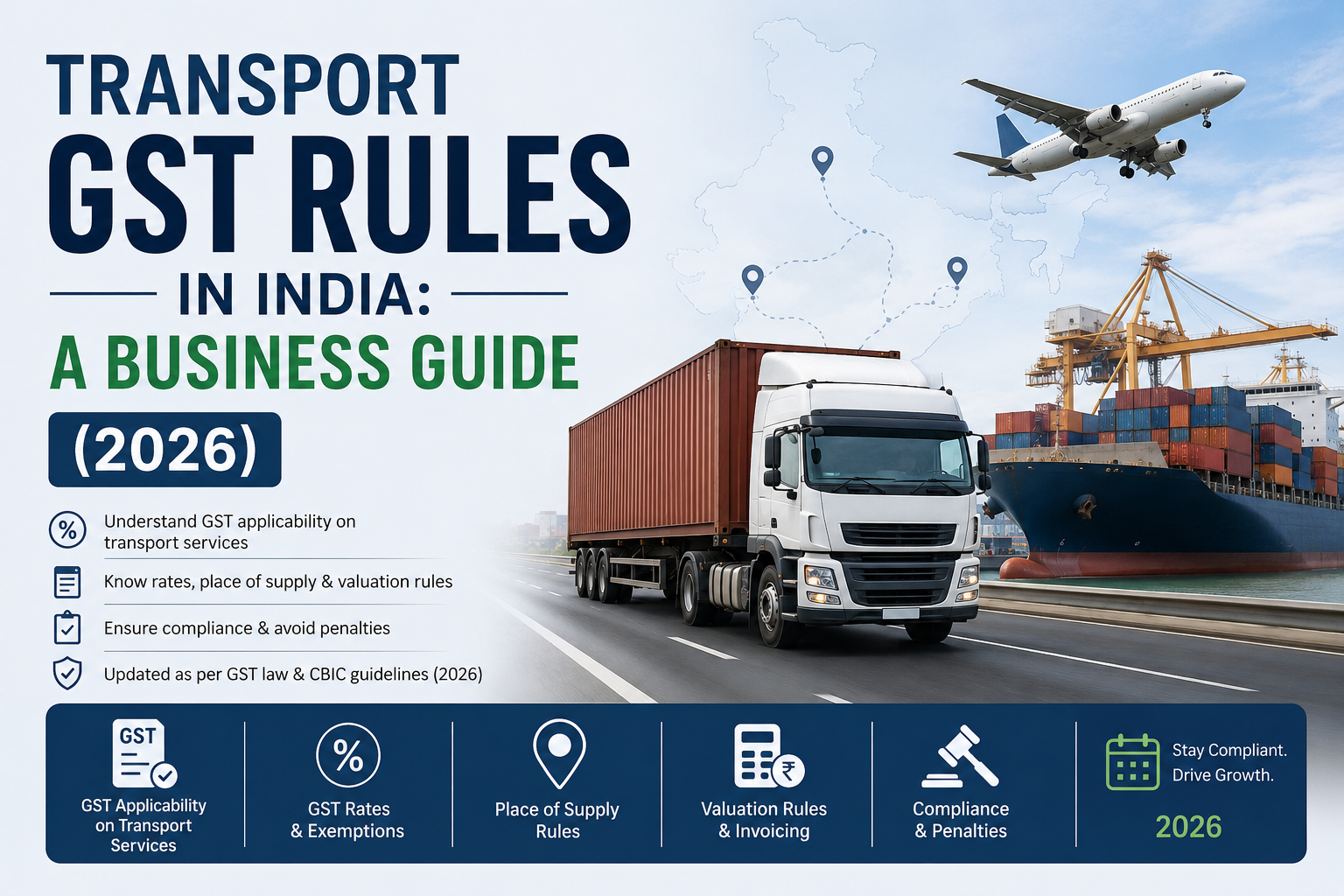
Transport GST Rules in India: A Complete Business Owner’s Guide (2026)
Introduction
You just received a freight invoice from your transporter. There’s a GST line item — but should you be paying it, or should they? Can you claim it back as Input Tax Credit? And what happens if the e-way bill wasn’t generated correctly?
If these questions sound familiar, you’re not alone. Transport GST rules in India remain one of the most misunderstood areas of compliance for business owners, manufacturers, and supply chain managers. A mistake here doesn’t just mean a penalty — it can disrupt your entire supply chain and block legitimate ITC claims.
This guide cuts through the confusion. Whether you ship goods from Mumbai to Delhi, run a manufacturing unit in Pune, or manage B2B logistics across multiple states, understanding how GST applies to freight is non-negotiable in 2026.
In this article, we’ll cover:
- GST rates applicable to road transport and GTAs
- How Reverse Charge Mechanism (RCM) works for freight
- E-way bill rules and thresholds
- How to correctly claim ITC on freight
- Common compliance mistakes — and how to avoid them
What Is a Goods Transport Agency (GTA) Under GST?
Before diving into rates, it’s important to understand how the GST law classifies transporters.
A Goods Transport Agency (GTA) is any person who provides road transport services for goods and issues a consignment note. This is a key distinction. Not every truck owner is a GTA. If a transporter does not issue a consignment note, different GST rules apply.
GTA vs. Independent Truck Owners
| Type | Issues Consignment Note? | GST Applicability |
|---|---|---|
| GTA | Yes | 5% (without ITC) or 12% (with ITC) |
| Independent truck owner | No | Exempt (if hired directly) |
Most organized logistics companies — including those offering FTL, PTL, and B2B logistics services — operate as GTAs. Therefore, the GTA GST rules apply to the majority of business freight movements in India.
Understanding this distinction helps you determine whether GST is applicable on a particular freight bill — and who is responsible for paying it.
GST Rates on Freight and Road Transport Services in 2026
The GST rate on freight services depends on who the GTA is and which option they have chosen under the GST framework.
Standard GTA GST Rates
- 5% GST (No ITC): The most common option. The GTA charges 5% GST but cannot claim Input Tax Credit on their own purchases (fuel, vehicle maintenance, etc.).
- 12% GST (With ITC): The GTA charges 12% GST and can claim ITC on their inputs. This option benefits GTAs with high operational costs.
Effective from FY 2023–24 onwards (and continuing in 2026), GTAs have the option to pay GST on a forward charge basis, meaning they pay the tax rather than their business clients. This is a significant operational change that every business owner must verify with their freight partner.
Exempt Transport Services
Certain transport services remain exempt from GST altogether:
- Transport of agricultural produce
- Transport of milk, salt, food grains (including flour and pulses)
- Transport of relief materials for disaster-affected areas
- Services where the total freight on a consignment does not exceed ₹1,500
If your cargo falls into exempt categories, ensure your transporter clearly documents this on the invoice to avoid unnecessary tax disputes.
Reverse Charge Mechanism (RCM) in Transport — What You Must Know
The Reverse Charge Mechanism (RCM) is one of the most frequently misunderstood aspects of GST on freight services.
When Does RCM Apply?
Under RCM, the recipient of the service pays GST instead of the supplier. In the context of road transport, RCM applies when:
- A registered business hires a GTA that has not opted for the forward charge mechanism
- The GTA’s services are not otherwise exempt
In such cases, the business receiving the freight service must:
- Pay GST directly to the government (not to the transporter)
- File this in their GST returns under RCM liability
- Claim this paid amount back as ITC, subject to eligibility conditions
Practical Example
Suppose a manufacturer in Nashik hires a GTA to ship goods to their distributor in Hyderabad. The GTA has not opted for forward charge. The freight bill is ₹50,000.
- GST applicable: 5% = ₹2,500
- The manufacturer pays ₹2,500 directly to the government as RCM
- The manufacturer can then claim ₹2,500 as ITC in their GSTR-3B
Getting this wrong — by either not paying RCM or paying it to the wrong party — is a common compliance error that attracts GST notices.
E-Way Bill Rules for Freight Movements in 2026
An e-way bill is a mandatory electronic document for the movement of goods worth more than ₹50,000 across India. For inter-state transport, there is no minimum threshold — an e-way bill is required regardless of value.
Key E-Way Bill Rules to Follow
- Generation: The e-way bill must be generated on the GST portal before the goods begin their journey.
- Validity: For road transport, the e-way bill is valid for one day per 200 km of distance. For ODC (Over Dimensional Cargo) transport, validity is one day per 20 km.
- Who generates it: The supplier, recipient, or transporter can generate the e-way bill. In practice, most organized transporters generate it on behalf of their clients.
- Part B Update: If the transporter changes mid-transit (e.g., for multi-modal or relay shipments), Part B of the e-way bill must be updated with the new vehicle details.
Consequences of Non-Compliance
Failure to carry a valid e-way bill during transit can result in:
- Detention of goods and vehicle at checkpoints
- Penalty of ₹10,000 or the tax amount (whichever is higher)
- Confiscation of goods in serious cases
For businesses running time-sensitive supply chains — such as FMCG, pharmaceuticals, or auto components — an e-way bill error can cost far more than the penalty itself.
Claiming Input Tax Credit (ITC) on Freight — Rules and Restrictions
ITC on freight is available, but it comes with specific conditions that many businesses overlook.
When You Can Claim ITC on Freight
You can claim ITC on GST paid on freight services if:
- The goods being transported are used for business purposes
- The GTA has charged 12% GST (with ITC) on a forward charge basis
- You have paid GST under RCM and the goods/services are eligible
When ITC Is Blocked
ITC on freight is not available if:
- The goods are used for personal consumption
- The freight is for exempt goods or services
- The transporter has charged 5% GST (no ITC option)
Pro tip: Always ask your transporter upfront which GST option they have opted for. This directly impacts your ITC eligibility and overall logistics cost.
Maintaining proper documentation — tax invoices, e-way bills, and GST returns — is essential for successfully claiming ITC during audits.
Why Choose Superior Transways for GST-Compliant Freight in India
Navigating transport GST rules becomes significantly easier when you work with a logistics partner who understands compliance as well as they understand roads.
Superior Transways, headquartered in Vasai, Mumbai, has been in the logistics and freight industry for 15+ years. With a PAN India network spanning 25+ states and a client base of over 4,000 businesses, they bring both scale and reliability to every shipment.
Here’s why India’s leading businesses trust Superior Transways:
- GST-Compliant Invoicing: All freight invoices are properly structured with correct GST treatment — so you never have to guess about RCM or ITC eligibility.
- E-Way Bill Management: Their team handles e-way bill generation and updates, reducing compliance risk for your team.
- Full Service Offering: From FTL and PTL services to ODC transportation, bulk cargo, warehouse services, and tempo on rent — all under one roof.
- Real-Time Tracking: Monitor your shipments live, so you’re always in control of your supply chain.
- 24/7 Support: Dedicated customer support ensures that any issue — from transit delays to documentation queries — is resolved quickly.
- Safe Cargo Handling: Trained loading/unloading teams and GPS-tracked vehicles ensure your goods arrive safely every time.
Whether you’re shipping auto parts from Pune, consumer goods from Surat, or industrial equipment from Gujarat, Superior Transways delivers with compliance and care. Explore their B2B logistics services to find the right solution for your business.
Frequently Asked Questions (FAQs) — Transport GST Rules in India
Is GST applicable on all road transport services?
No. GST applies when a registered Goods Transport Agency (GTA) provides the service. Services from unregistered individual truck owners without a consignment note are generally exempt. Also, transport of certain goods like agricultural produce, grains, and milk is exempt from GST regardless of the transporter.
Who pays GST under RCM in transport — the transporter or the business?
Under the Reverse Charge Mechanism, the business hiring the GTA (i.e., the recipient of the service) pays GST directly to the government. The transporter does not collect GST in this case. This applies when the GTA has not opted for forward charge.
What is the current GST rate on freight charges in India in 2026?
The GST rate on GTA services is either 5% (without ITC for the GTA) or 12% (with ITC for the GTA). The applicable rate depends on the option chosen by the GTA. For most businesses, the 5% rate under RCM is the most commonly encountered scenario.
Can I claim ITC on the GST I pay on freight?
Yes, you can claim ITC on freight GST if the goods transported are used for business purposes and the freight relates to taxable supplies. ITC is available when you pay GST under RCM or when the GTA charges 12% on a forward charge basis. Keep all tax invoices and e-way bill records for audit readiness.
What happens if an e-way bill is not generated for my shipment?
If goods are transported without a valid e-way bill where one is required, the transporter and the business can face a penalty of ₹10,000 or the tax evaded (whichever is higher). Goods may also be detained until the issue is resolved. Always ensure your logistics partner generates e-way bills before dispatch.
Conclusion
Transport GST rules in India are detailed — but they don’t have to be a source of stress for your business. The key takeaways are clear: know whether your transporter is a GTA, understand whether RCM or forward charge applies, ensure e-way bills are correctly generated, and maintain clean documentation to protect your ITC claims.
Staying compliant with transport GST rules in India not only protects you from penalties but also improves your cash flow through accurate ITC recovery.
The best way to simplify logistics compliance is to work with an experienced, GST-compliant freight partner. Superior Transways has been helping 4,000+ businesses across India ship smarter and stay compliant for over 15 years