How Transport Pricing Works in India: A Complete Guide for Businesses
Introduction
You’ve booked a truck. The invoice arrives — and the number surprises you. Sound familiar?
For thousands of business owners, manufacturers, and supply chain managers across India, understanding transport pricing in India feels like solving a puzzle. Rates change. Quotes vary between providers. And hidden charges often appear after delivery.
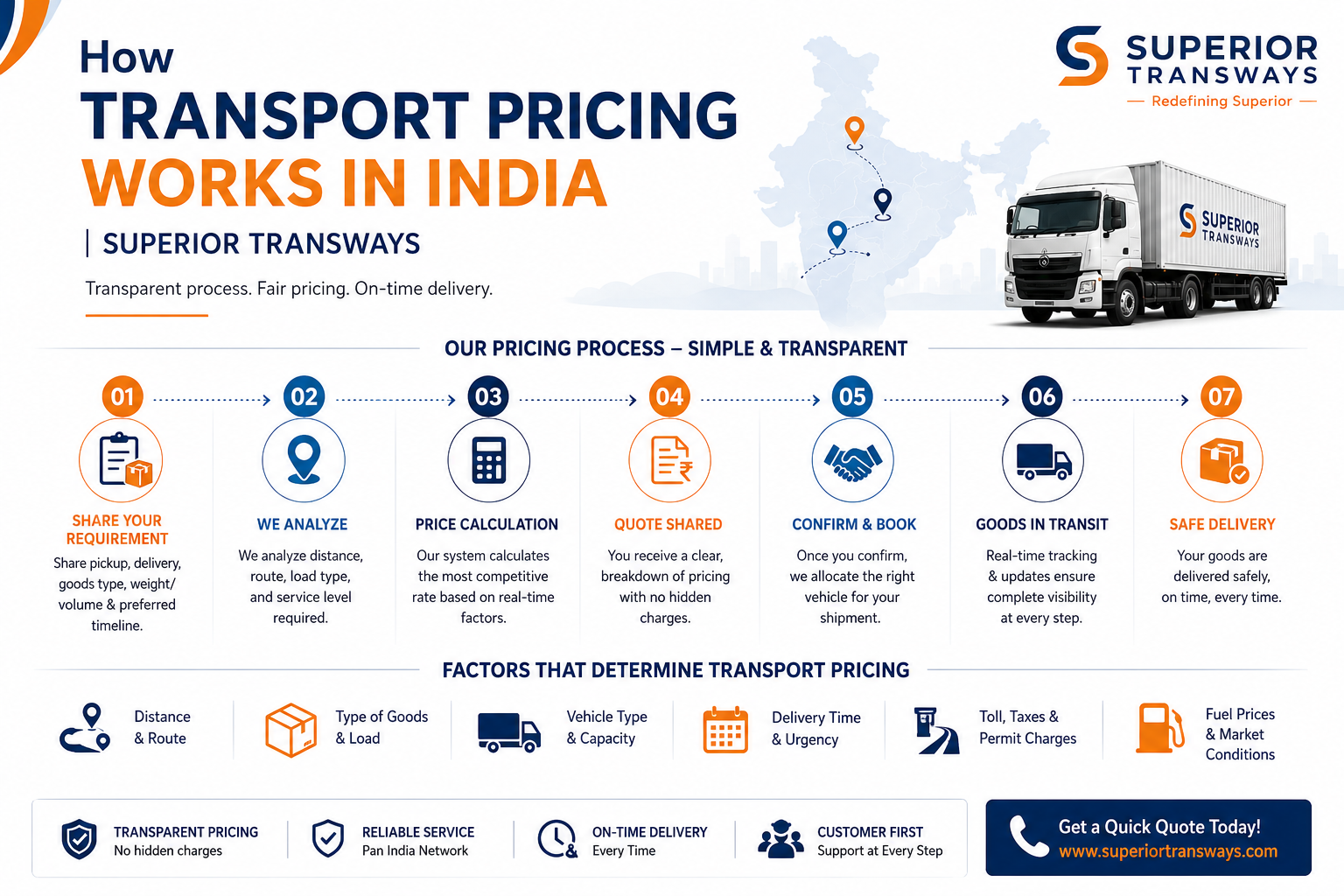
The truth is, freight pricing isn’t random. It follows a clear logic — driven by distance, load type, route conditions, and service level. Once you understand how it works, you can plan your logistics budget accurately, negotiate better, and choose the right transport partner.
In this guide, we break down exactly how road transport pricing is calculated in India — covering FTL and PTL rates, key cost drivers, seasonal factors, and what to watch for when comparing quotes. Whether you’re shipping from Mumbai to Chennai or Ahmedabad to Delhi, this article gives you the clarity you need.
The Two Core Pricing Models: FTL vs PTL
The first decision that affects freight charges in India is whether you need a Full Truck Load (FTL) or Part Truck Load (PTL) service.
Full Truck Load (FTL) Pricing
With FTL, you book the entire truck — regardless of whether you fill it completely. Pricing is typically based on:
- Distance (per km rate): The most common method. A transporter quotes a rate per kilometre based on truck type (e.g., 20-ft container, 32-ft trailer).
- Fixed route pricing: For regular lanes like Mumbai–Pune or Delhi–Jaipur, transporters often offer a flat trip rate.
- Vehicle type: A 7-tonne vehicle costs less than a 25-tonne multi-axle truck.
FTL is ideal when your cargo fills 60–100% of the truck. It’s faster, involves fewer handling touchpoints, and reduces damage risk.
👉 [Explore Superior Transways’ FTL Services at superiortransways.com/ftl-services]
Part Truck Load (PTL) Pricing
PTL is for smaller shipments that don’t need a full truck. Here, cargo from multiple clients shares a single vehicle. Pricing is typically calculated by:
- Weight (per kg or per tonne)
- Volume/dimensional weight — whichever is higher
- Number of boxes or packages
PTL is cost-effective for small-to-medium businesses shipping 50 kg to 2,000 kg. However, transit time is usually longer due to multiple pickups and drops.
Key Factors That Drive Freight Charges in India
Transport pricing in India is not one-size-fits-all. Several variables directly influence what you pay.
1. Distance and Route
The longer the route, the higher the base freight cost. However, route quality also matters. A 500 km lane on a well-maintained national highway costs less to service than a 300 km route through hilly terrain or flood-prone areas. Lanes like Mumbai–Nagpur or Delhi–Ludhiana are competitive because of high truck density and return loads.
2. Cargo Type and Nature
Fragile goods, hazardous materials, perishables, or high-value electronics require special handling — and special pricing. Similarly, oddly shaped or oversized cargo (called ODC — Over Dimensional Cargo) requires custom vehicles and permits, which adds to the cost.
3. Truck Type and Capacity
India’s road transport fleet includes:
- Mini trucks / Tempos (up to 1.5 tonnes)
- Medium trucks (up to 7 tonnes)
- Large trucks / Trailers (up to 35+ tonnes)
Larger vehicles cost more per trip but offer a lower cost per kg. Choosing the right vehicle size is critical to optimising logistics costs.
4. Fuel Prices
Diesel prices directly impact transport rates across India. When fuel prices rise, transporters pass on a portion as a fuel surcharge or revised per-km rate. Since diesel rates vary by state, this also creates regional pricing differences.
5. Loading/Unloading and Dwell Time
Extra charges apply if the truck waits beyond a standard window (usually 2–4 hours) at a loading or unloading point. These are called detention or demurrage charges. Efficient warehouse operations on your end can help avoid these fees.
Understanding Additional Charges in Transport Bills
Many businesses are caught off-guard by line items that appear beyond the basic freight rate. Here’s what to watch for:
| Charge Type | What It Covers |
|---|---|
| Fuel Surcharge | Adjustment for diesel price fluctuations |
| Toll & State Tax | Highway tolls and inter-state entry taxes |
| Loading/Unloading Charges | Labour cost at origin or destination |
| Detention Charges | Truck waiting beyond agreed free hours |
| ODC Permit Charges | For oversized or overweight cargo |
| Insurance/Risk Cover | Cargo protection during transit |
| Packaging/Wrapping | For fragile or high-value goods |
A transparent transporter will itemise these clearly. Always ask for a breakup before confirming any shipment.
How Seasonal and Market Factors Affect Road Transport Rates
Transport pricing in India also shifts with the season and market conditions.
- Festive season (October–December): Demand for trucks spikes ahead of Diwali and year-end. Rates increase by 10–25% on high-density lanes.
- Monsoon season (June–September): Challenging road conditions in states like Maharashtra, Assam, and Himachal Pradesh increase transit risk and cost.
- Agricultural cycles: Post-harvest seasons in Punjab, UP, and AP increase truck demand for bulk commodities — pushing up PTL and FTL rates.
- Backload availability: If a transporter has a return load on a route, they often offer discounted rates. Regular shippers who commit to volume get better pricing.
Building a long-term relationship with a reliable transport partner is one of the most effective ways to stabilise your cargo transportation charges year-round.
Why Choose Superior Transways for Your Logistics Needs?
Understanding transport pricing is one thing — finding a partner who offers honest, competitive rates with zero surprises is another.
Superior Transways, headquartered in Vasai, Mumbai, has been one of India’s trusted logistics partners for 15+ years. With a PAN India network spanning 25+ states and a client base of over 4,000 businesses, they bring unmatched expertise to every shipment.
Here’s what sets them apart:
- Transparent pricing: No hidden charges. Clear, itemised quotes before every booking.
- Full service range: FTL, PTL, ODC Transportation, B2B Logistics, Bulk Transportation, Warehouse Services, and Tempo on Rent — all under one roof.
- Real-time tracking: Monitor your shipment 24/7 through their tracking system.
- Safe cargo handling: Trained teams and quality packaging ensure your goods arrive intact.
- 24/7 customer support: Dedicated relationship managers available round the clock.
- Pan India coverage: From metros like Delhi, Bangalore, and Hyderabad to Tier-2 cities, no destination is out of reach.
Whether you’re a manufacturer in Pune, a retailer in Surat, or an e-commerce business in Delhi, Superior Transways has a cost-optimised solution for your exact requirements.
👉 [Learn more about B2B Logistics at superiortransways.com/b2b-logistics]
Frequently Asked Questions (FAQ)
How is freight cost calculated per km in India?
Freight cost per km depends on truck type, cargo weight, and route. For FTL, a standard 20-ft container typically ranges from ₹30–₹65 per km depending on the lane and season. PTL rates are calculated per kg or per tonne. Always get a detailed quote that breaks down base freight, surcharges, and taxes for accuracy.
What is the difference between FTL and PTL pricing?
FTL pricing is based on the full truck being reserved for your cargo — usually charged per km or as a fixed trip rate. PTL pricing is based on your cargo’s actual weight or volume, as you share the truck with other shippers. FTL is faster and safer for large loads; PTL is more economical for smaller consignments.
Why do transport rates vary between cities in India?
Rates vary due to differences in fuel prices, toll structures, road quality, truck availability, and backload opportunities on each lane. High-frequency corridors like Mumbai–Delhi or Chennai–Bangalore tend to be more competitive. Remote or hilly destinations carry a premium due to limited truck availability and difficult terrain.
What are ODC transportation charges?
ODC (Over Dimensional Cargo) refers to shipments that exceed standard size or weight limits — such as industrial machinery, windmill blades, or large steel structures. ODC transportation requires special permits from state authorities, escort vehicles in some cases, and custom trailers. These requirements add to the base transport cost.
How can businesses reduce their logistics costs in India?
Businesses can lower logistics costs by: consolidating smaller shipments into PTL or FTL loads, committing to regular volume with a single transport partner for better rates, optimising packaging to reduce dimensional weight, planning shipments outside peak festive demand periods, and working with a full-service logistics provider who can offer end-to-end solutions including warehousing.
Conclusion
Transport pricing in India depends on multiple interconnected factors — distance, load type, vehicle, route, season, and service level. Understanding these variables gives your business a major advantage: you can budget accurately, avoid surprise charges, and choose partners who offer genuine value.
The right transport partner makes all the difference. With clear pricing, PAN India reach, and deep operational expertise, Superior Transways is equipped to handle your logistics — from a single PTL consignment to complex multi-state B2B freight movements.