Warehouse vs 3PL: Which Logistics Model Is Right for Your Business in India?
Introduction
You’ve just landed a bulk order from a retailer in Pune — but your storage facility in Delhi is full, your trucks aren’t available, and your team is stretched thin. Sound familiar? For thousands of Indian businesses, this scenario plays out every week. The question of warehouse vs 3PL sits at the heart of it.
Should you manage your own warehouse and fleet? Or should you outsource to a third-party logistics (3PL) provider? This is one of the most critical decisions for manufacturers, retailers, and distributors operating across India’s vast and complex supply chain landscape.
In this article, we break down the key differences between traditional warehousing and 3PL logistics, explore the pros and cons of each, and help you decide which model best fits your business — whether you’re shipping 10 pallets or 10,000.
What Is Traditional Warehousing?
Owning and Operating Your Own Storage Infrastructure
Traditional warehousing means a business owns, leases, or directly manages its storage facilities. You control the space, the staff, and the operations. This model is common among large manufacturers and retailers who have consistent, high-volume storage needs.
Key features of a traditional warehouse setup:
- Dedicated storage space owned or leased by the business
- In-house staff for inventory management and dispatch
- Full control over processes, layouts, and technology
- Fixed costs regardless of inventory fluctuations
For Indian businesses with steady, predictable inventory — such as FMCG companies, automobile component manufacturers, or large retail chains — owning a warehouse can offer long-term cost efficiencies. However, it also demands significant capital investment in real estate, manpower, security, and technology.
The challenge? India’s logistics infrastructure varies dramatically between metro cities like Mumbai and Bangalore, and Tier 2 or Tier 3 cities. Maintaining warehouse operations across multiple states means navigating different labour laws, compliance norms, and local challenges — all while managing your core business.
What Is 3PL (Third-Party Logistics)?
Outsourcing Your Logistics to the Experts
Third-party logistics, or 3PL, refers to outsourcing warehousing, transportation, and supply chain functions to a specialised external provider. A 3PL partner handles storage, order fulfilment, freight movement, and often last-mile delivery — so you don’t have to.
What a 3PL provider typically offers:
- Shared or dedicated warehousing space
- Inventory management and order fulfilment
- FTL (Full Truck Load) and PTL (Part Truck Load) transportation
- Real-time shipment tracking
- PAN India distribution network
- Scalability to handle seasonal demand spikes
In India, the 3PL sector has grown rapidly thanks to the GST rollout, the expansion of e-commerce, and rising demand for efficient supply chains. Businesses from pharmaceuticals to retail to auto components are shifting towards 3PL models to reduce overheads and improve delivery speed.
For businesses looking to expand into new states without building fresh infrastructure, a 3PL partner is often the smartest and fastest route to growth.
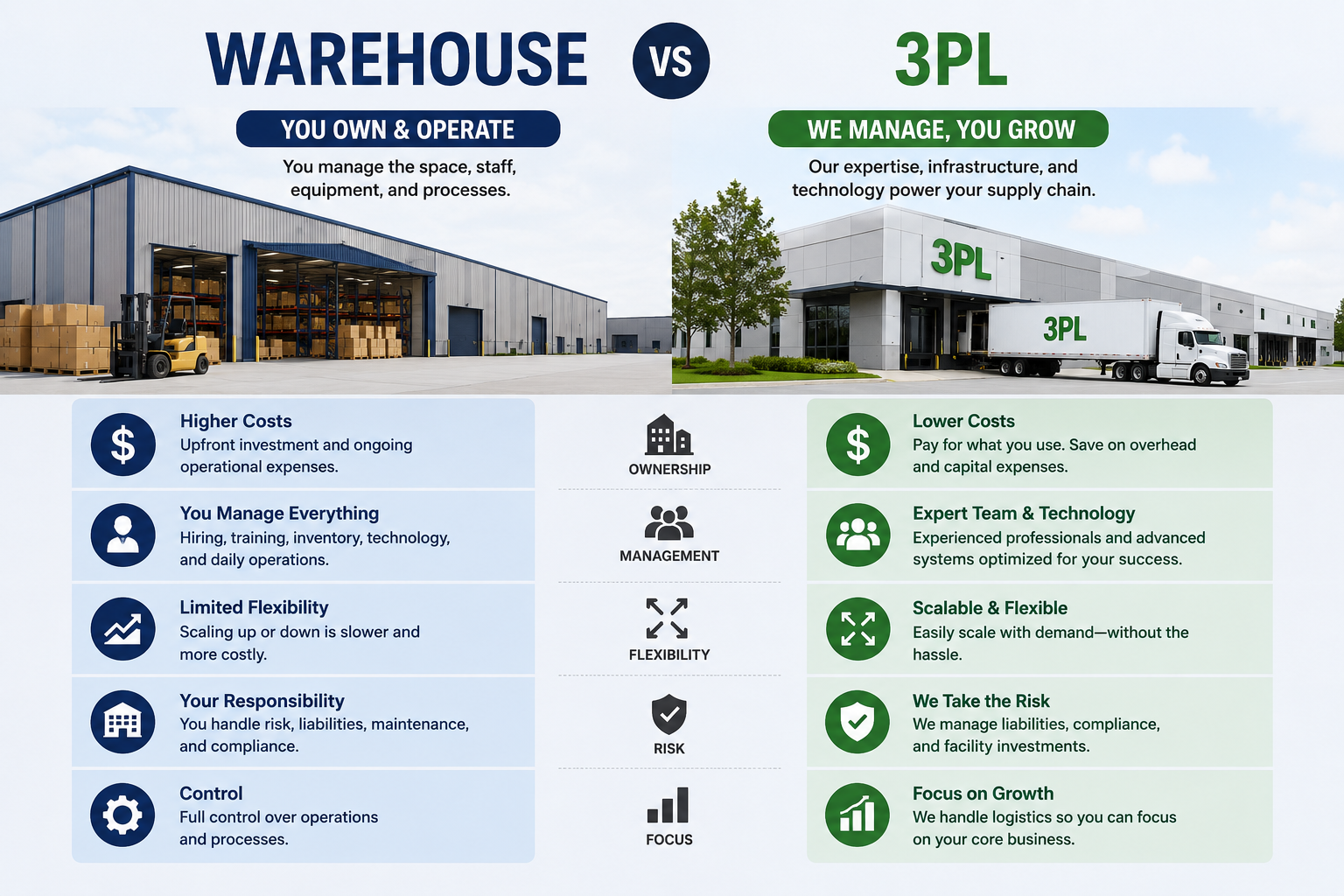
Warehouse vs 3PL — Head-to-Head Comparison
Understanding the practical differences between both models helps you make a more informed decision. Here’s how they compare across the factors that matter most to Indian businesses:
| Factor | Traditional Warehouse | 3PL Provider |
|---|---|---|
| Capital Investment | High (real estate, staff, tech) | Low (pay-as-you-use) |
| Flexibility | Low (fixed capacity) | High (scales with demand) |
| Geographic Reach | Limited to owned locations | PAN India coverage |
| Control | Full control over operations | Shared/managed control |
| Expertise | Requires in-house logistics team | Expert logistics professionals |
| Technology | Must invest separately | Included (WMS, tracking) |
| Risk | Higher (fixed costs during low season) | Lower (variable costs) |
| Time to Set Up | Months to years | Days to weeks |
When Traditional Warehousing Makes Sense
Traditional warehousing suits businesses that:
- Have consistent, year-round, high-volume inventory
- Operate in a single or limited geography
- Want complete control over sensitive or regulated goods
- Have the capital to invest in long-term infrastructure
When 3PL Is the Smarter Choice
3PL logistics is ideal for businesses that:
- Are scaling rapidly across multiple Indian states
- Experience seasonal demand fluctuations (e.g., festive season spikes)
- Want to reduce fixed overheads and convert to variable costs
- Lack in-house logistics expertise or technology
- Need PAN India distribution without building from scratch
Key Benefits of Choosing a 3PL Partner in India
Outsourcing logistics to a reliable 3PL provider in India offers several tangible advantages, especially in a market as diverse and geographically vast as ours.
1. Cost Efficiency You pay only for the space and services you use. No idle warehouse costs during off-season periods.
2. Faster Market Expansion A 3PL partner with a national network lets you reach customers in Kolkata, Chennai, Ahmedabad, or Hyderabad — without setting up local offices or warehouses.
3. Technology Without Investment Most modern 3PL providers offer Warehouse Management Systems (WMS) and real-time tracking as part of the package — technology that would otherwise cost lakhs to implement independently.
4. Focus on Core Business When logistics is handled externally, your team can focus on sales, production, and growth — not truck schedules and inventory audits.
5. Risk Mitigation Compliance, labour management, and transportation risks are transferred to the 3PL partner, who specialises in managing them.
Why Choose Superior Transways for Your Logistics Needs?
If you’re evaluating warehouse vs 3PL options in India, Superior Transways — headquartered in Vasai, Mumbai — offers a compelling case for outsourced logistics excellence.
With 15+ years of industry experience and a network spanning 25+ states, Superior Transways has built a reputation as a trusted logistics partner for over 4,000 business clients across India. Whether you’re a manufacturer in Pune, a retailer in Surat, or a distributor in Lucknow, their PAN India reach ensures your cargo moves efficiently.
Here’s what sets Superior Transways apart:
- Comprehensive service portfolio: FTL, PTL, ODC Transportation, B2B Logistics, Bulk Transportation, Warehouse Services, and Tempo on Rent — all under one roof
- Real-time tracking: Know exactly where your shipment is at every point in the journey
- Safe cargo handling: Trained teams and the right equipment to handle goods of all sizes and sensitivities
- 24/7 customer support: Round-the-clock assistance for time-sensitive logistics needs
- Scalable solutions: Whether it’s a single consignment or a long-term supply chain partnership, Superior Transways scales with your business
Looking for reliable B2B logistics services or need a dependable full truck load partner for your next bulk shipment? Superior Transways has the infrastructure, expertise, and network to deliver.
Frequently Asked Questions (FAQs)
What is the main difference between a warehouse and 3PL?
A traditional warehouse is a storage facility owned or leased by a business to manage its own inventory. A 3PL (third-party logistics) provider offers outsourced warehousing, transportation, and fulfilment services. The key difference is control vs. flexibility — warehouses give you full control but come with high fixed costs, while 3PL offers scalability and expertise at variable cost.
Is 3PL suitable for small and medium businesses in India?
Yes, 3PL is particularly well-suited for SMEs. It eliminates the need for heavy upfront investment in infrastructure. Smaller businesses can access PAN India logistics networks, advanced tracking technology, and professional fulfilment capabilities that would otherwise be out of reach. It allows SMEs to compete on the same level as larger players.
How does 3PL help with seasonal demand in India?
Indian businesses often see sharp demand spikes during festivals like Diwali, Eid, or year-end sales. A 3PL provider can scale storage and transportation capacity up or down based on your actual needs — so you never overpay during slow months or scramble for trucks during peak season.
What types of goods can be stored and transported through a 3PL provider?
A reliable 3PL partner handles a wide range of goods — from FMCG products and industrial equipment to pharmaceuticals, auto components, and retail merchandise. For oversized or heavy goods, services like ODC (Over-Dimensional Cargo) transportation ensure safe and compliant movement.
How do I choose the right logistics partner in India?
Look for a 3PL partner with a proven PAN India network, industry experience, transparent pricing, real-time tracking capabilities, and strong client references. Evaluate their service range — does it include FTL, PTL, warehousing, and specialised transport? A partner like Superior Transways, with 15+ years of experience and 4,000+ clients, checks all these boxes.
Conclusion
The warehouse vs 3PL debate doesn’t have a one-size-fits-all answer. For businesses with large, steady inventory and deep pockets, in-house warehousing can work well. But for the vast majority of Indian businesses — especially those looking to scale, reduce costs, and expand into new markets — partnering with an experienced 3PL provider is the smarter path forward.
The right logistics partner doesn’t just store and move your goods. They become an extension of your business, helping you deliver faster, operate leaner, and grow with confidence.