
Commercial transportation is an essential part of running a successful business. Whether you operate a manufacturing unit, wholesale distribution business, trading company, retail chain, or industrial warehouse, moving goods safely and on time directly affects your operations. A delayed shipment can disrupt production schedules, create stock shortages, disappoint customers, and increase operating costs.
This is why choosing the right Transport Company in Navi Mumbai is more than a matter of comparing freight rates. Businesses need a transportation partner that understands their cargo requirements, provides suitable vehicles, communicates clearly, manages documentation, and coordinates deliveries efficiently.
Navi Mumbai is an important commercial and logistics region, serving businesses across industrial areas, warehouses, distribution centres, and trading hubs. Companies operating in and around Taloja, Turbhe, TTC Industrial Area, Rabale, Mahape, APMC Market, and nearby commercial zones may need regular transportation for raw materials, finished products, machinery, packaging materials, and bulk goods.
With multiple transport providers available, how can you identify the right one for your business?
This guide explains the essential factors to consider when selecting a transport company in Navi Mumbai for commercial loads, including vehicle availability, Full Truck Load services, pricing, cargo safety, tracking, documentation, delivery commitments, and customer support.
Why Choosing the Right Transport Company Matters
For commercial businesses, transportation is closely connected to inventory management, customer satisfaction, and profitability. A transport provider that cannot meet your requirements may create problems even when its initial quotation appears attractive.
Consider a manufacturer that needs to send finished goods to a distributor in another state. If the truck arrives late, loading is delayed, or the consignment reaches the destination after the agreed delivery window, the manufacturer may face additional handling costs, delayed payments, or dissatisfied customers.
A dependable transportation partner helps businesses plan dispatches more effectively and reduce avoidable uncertainty.
The right transport company can help you:
- Arrange suitable vehicles according to cargo dimensions, weight, and volume.
- Plan pickups and deliveries around dispatch schedules.
- Coordinate commercial goods movement across different Indian states.
- Reduce avoidable delays caused by poor communication.
- Improve visibility through shipment updates and tracking arrangements.
- Maintain proper transportation documentation.
- Establish a consistent process for recurring shipments.
- Control total logistics costs rather than focusing only on the lowest quotation.
For businesses shipping goods frequently, the objective should be to develop a reliable transportation arrangement that supports long-term growth.
1. Check the Company’s Experience with Commercial Loads
The first step is to understand whether the transport provider has experience handling cargo similar to yours.
Commercial loads differ significantly from household shifting or small parcel deliveries. A business might need to transport industrial equipment, construction materials, textiles, electrical goods, consumer products, chemicals, or packaged food products. Each cargo category may have different handling, vehicle, safety, and documentation requirements.
Before finalising a transport company in Navi Mumbai, ask the following questions:
- Does the company regularly handle commercial and industrial consignments?
- Can it arrange transportation for your cargo category?
- Does it understand your pickup and delivery locations?
- Can it support both occasional and recurring shipments?
- Does it have a process for resolving delays, damage, or delivery disputes?
- Can it provide references or verifiable examples of relevant experience?
Experience should be evaluated against your actual requirements. A provider that primarily handles small local deliveries may not be the best fit for a large industrial shipment moving across several states.
For example, a business dispatching machinery from Navi Mumbai to Gujarat may need a different arrangement from a distributor shipping pallets of packaged goods to several destinations.
Practical tip: Share a realistic description of your cargo and transport frequency when requesting quotations. This helps the transporter assess the job accurately and reduces the risk of unexpected changes later.
2. Understand the Available Transportation Services
Not every commercial shipment requires the same transport arrangement. Before choosing a provider, identify the service that best matches your shipment size, urgency, and budget.
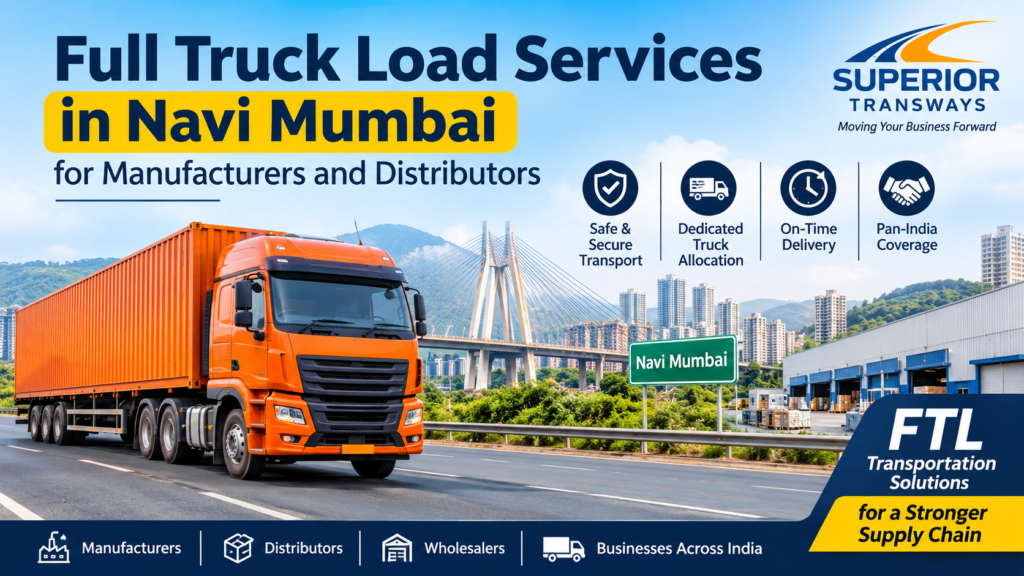
Full Truck Load (FTL) transportation
Full Truck Load transportation is generally suitable when a business needs a dedicated truck for a consignment or wants the available vehicle capacity allocated to its shipment.
FTL can be useful for:
- Large manufacturing consignments.
- Bulk distribution of finished goods.
- Industrial and construction materials.
- Factory-to-warehouse transfers.
- Regular interstate commercial dispatches.
- Shipments requiring dedicated vehicle arrangements.
The main advantage is that the vehicle is assigned to the shipment according to the agreed arrangement. The actual transit time, loading plan, and cost depend on the route, cargo, vehicle, and operating conditions.
If your business frequently dispatches substantial quantities of goods, compare the available Full Truck Load transportation services and vehicle options before booking.
Part Truck Load (PTL) transportation
Part Truck Load transportation can be appropriate when your shipment does not require the capacity of an entire truck. The shipment may share transport capacity with other compatible consignments.
PTL can help smaller commercial shipments avoid paying for an entire vehicle, although the final cost and transit time depend on the provider’s network, handling requirements, and consolidation schedule.
Ask whether the provider accepts your cargo dimensions, weight, packaging, and delivery requirements.
Dedicated vehicle or tempo transportation
A dedicated smaller commercial vehicle or tempo may be useful for local deliveries, urgent dispatches, samples, smaller consignments, or movements between warehouses and distribution points.
Choose the vehicle based on actual payload capacity and usable cargo dimensions rather than appearance alone.
Specialised and oversized cargo transportation
Machinery, oversized industrial equipment, and unusually heavy consignments may require specialised vehicles, loading equipment, route planning, permits, or escorts, depending on the load and applicable requirements.
Confirm that the transporter can arrange the necessary equipment and compliance before committing to a dispatch date.
The best transport company will explain which service fits your shipment instead of recommending the same vehicle type for every requirement.
3. Evaluate Vehicle Availability and Fleet Options
Vehicle suitability is one of the most important factors in commercial transportation. An unsuitable truck can create loading problems, increase handling costs, or make the movement unsafe.
When discussing a booking, provide the transporter with:
- Total cargo weight.
- Approximate length, width, and height.
- Number of packages, pallets, or units.
- Type of packaging.
- Whether the cargo is fragile, moisture-sensitive, or unusually heavy.
- Loading and unloading arrangements.
- Pickup and delivery access restrictions.
Based on these details, ask which vehicle is appropriate for the shipment.
Depending on the provider’s available fleet and operating arrangements, commercial vehicle options may include 14-foot, 17-foot, 19-foot, 20-foot, 22-foot, 32-foot, and larger vehicles or trailers. These labels can refer to different body styles and configurations, so they should not be treated as a guarantee of payload capacity or internal dimensions.
A larger truck is not automatically the best choice. The correct vehicle must accommodate both the cargo’s physical dimensions and its weight while meeting applicable road and vehicle restrictions.
Also confirm whether the vehicle is directly operated by the company or arranged through a transport partner. Either model can work, provided responsibility, vehicle details, service standards, and communication arrangements are clear.
Before loading: Confirm the vehicle type, registration details where applicable, reporting time, and any special loading requirements.
4. Compare Transportation Rates and the Total Cost
Price is important, but choosing a transporter solely because it offers the lowest rate can be expensive in the long run.
Commercial freight quotations may vary according to:
- Pickup and delivery locations.
- Distance and route conditions.
- Vehicle type and payload requirements.
- Shipment weight, dimensions, and cargo category.
- Availability of return loads or vehicles.
- Loading and unloading responsibilities.
- Waiting time and detention arrangements.
- Toll charges, permits, and other applicable expenses.
- Transit insurance or other agreed coverage.
- Urgency and delivery scheduling requirements.
When comparing quotations, ask for a clear breakdown of what is included and excluded. One provider may include certain route expenses while another may quote a base freight rate and charge additional items separately.
A useful comparison should cover the same origin, destination, cargo details, vehicle specification, loading plan, and delivery expectations.
For instance, if two providers quote different rates for transporting the same industrial consignment, verify whether both quotations include the same vehicle capacity, loading arrangements, tolls, insurance provisions, and waiting-time terms.
Do not assume that a lower quotation includes every service.
Questions to ask before accepting a quotation
- Is the quoted rate inclusive of applicable tolls and other agreed charges?
- Are loading and unloading included?
- What happens if the vehicle must wait at the pickup or delivery point?
- Is there any additional charge for route changes or delivery restrictions?
- What are the payment terms?
- Are taxes shown separately where applicable?
- Is transit insurance included, optional, or the customer’s responsibility?
- How are cancellations and rescheduling handled?
Request the final commercial terms in writing. Clear pricing helps you budget accurately and prevents misunderstandings during dispatch or delivery.
5. Verify Cargo Safety and Insurance Arrangements
Cargo safety should be a major consideration when choosing a commercial transport provider. Damage, loss, moisture exposure, poor loading, and inadequate securing can create financial and operational problems.
A responsible transporter should be able to explain the precautions used for your type of shipment and clarify which party is responsible for each part of the process.
Depending on the cargo, safety measures may include:
- Appropriate packaging and palletisation.
- Correct weight distribution.
- Suitable ropes, straps, restraints, or other securing equipment.
- Protection against rain, dust, and moisture where required.
- Safe loading and unloading procedures.
- Vehicle suitability and condition checks.
- Clear documentation of cargo quantity and condition.
Fragile goods, machinery, electronics, and moisture-sensitive materials may require additional precautions. Tell the transporter about these requirements before the vehicle arrives.
Understand transit insurance
Do not assume that every shipment is automatically covered by insurance. Ask whether transit insurance is available, who arranges it, what the policy covers, and which exclusions, limits, deductibles, and claim procedures apply.
Clarify whether the quoted freight includes insurance or whether it must be purchased separately. Confirm the insured value and documentation requirements before dispatch.
If damage or loss occurs, photographs, consignment records, delivery remarks, invoices, and timely notification may be important for assessing a claim. Follow the insurer’s actual policy terms and reporting deadlines.
A company that explains safety responsibilities and insurance arrangements clearly is easier to work with than one that makes broad promises without explaining the conditions.
6. Check Delivery Timelines and Route Planning
Timely delivery matters for manufacturers, distributors, retailers, and wholesalers. A delay can affect production schedules, customer commitments, warehouse space, and inventory availability.
However, a delivery promise should be realistic and based on the route, vehicle, cargo, and dispatch conditions.
Before booking, discuss:
- Expected vehicle reporting time.
- Loading completion time.
- Planned dispatch date.
- Estimated transit time.
- Delivery appointment or receiving-hour restrictions.
- Possible route restrictions.
- Holiday or peak-season considerations.
- Procedures for communicating unexpected delays.
A transporter should distinguish between an estimated delivery window and a guaranteed commitment. Traffic congestion, weather, road restrictions, vehicle breakdowns, and loading delays may affect transit.
For businesses transporting goods from Navi Mumbai to another state, route planning should account for the pickup site’s location, destination access, road conditions, and any restrictions that apply to the vehicle or cargo.
Do not select a provider only because it promises the fastest delivery. Evaluate whether the timeline is feasible and whether the company has a clear process for managing exceptions.
Best practice: Share your actual delivery deadline, not just your preferred dispatch date. This helps the transport provider assess whether the requested schedule is practical.
7. Look for Shipment Tracking and Proactive Communication
Visibility is particularly important when goods are moving between cities or states. If your team cannot obtain reliable shipment updates, it becomes difficult to plan warehouse receiving, inform customers, or respond to delays.
Ask what tracking and communication options the transporter offers. These may include GPS-based tracking where available, telephone updates, messaging updates, dispatch confirmations, and delivery confirmation.
Before booking, establish:
- Who will be your primary point of contact?
- How will dispatch be confirmed?
- How often can shipment updates be expected?
- Who will notify you about a delay?
- Can the receiving party be contacted before delivery?
- Will proof of delivery be shared after unloading?
Not every transport provider offers a digital tracking portal. That alone does not determine reliability, but the company should explain how shipment status will be communicated.
A simple, consistent communication process can help your dispatch, sales, procurement, and warehouse teams coordinate more effectively.
8. Confirm Documentation and Regulatory Compliance
Commercial goods transportation requires appropriate documentation. The documents needed depend on the goods, transaction, route, applicable tax rules, and nature of the movement.
Before dispatch, confirm who will prepare and verify the required paperwork.
Documents commonly relevant to commercial consignments may include:
- Invoice or bill of supply, as applicable.
- Delivery challan where appropriate.
- E-way bill, when required under applicable GST rules.
- Lorry receipt (LR) or goods receipt.
- E-invoice documentation, where applicable.
- Packing list or cargo details for relevant shipments.
- Special permits or supporting documents for regulated or oversized loads, where required.
The list is not universal. Your business’s tax adviser or compliance team should determine which documents apply to a specific transaction.
Why e-way bill coordination matters
For eligible movements of goods, an e-way bill may be required under applicable GST rules. The responsibilities for generating it and completing vehicle details depend on the circumstances and the relevant provisions.
The consignor, consignee, and transporter should coordinate the necessary information before dispatch. Incorrect vehicle details, missing documentation, or incomplete records may lead to avoidable complications.
Share accurate invoice and shipment information with the transporter, and confirm who is responsible for each required step.
For official guidance, consult the GST Council’s e-way bill resource and the applicable rules or portal instructions.
A reliable transport partner should be willing to clarify its documentation responsibilities rather than leaving important details unresolved until the vehicle is ready to depart.
9. Assess Customer Support and Problem Resolution
Transportation involves multiple moving parts. Even with good planning, a vehicle may face a breakdown, loading may take longer than expected, or the consignee may be unavailable.
The way a company responds to these situations is an important indicator of service quality.
Before selecting a transporter, find out how it handles operational problems. Ask whether you will receive a dedicated contact person, how urgent issues are escalated, and how the company records complaints or delivery discrepancies.
Good customer support includes:
- Clear communication before dispatch.
- Timely confirmation of vehicle placement.
- Updates when the schedule changes.
- Assistance with documentation queries.
- Coordination with pickup and delivery teams.
- A defined process for damage or shortage reports.
- Access to delivery confirmation and relevant records.
Do not rely exclusively on a salesperson’s assurances. Where possible, request references from existing commercial customers or examine independently verifiable reviews.
If your company ships regularly, consistent service and responsive problem-solving can be more valuable than a small difference in the freight rate.
10. Check Service Coverage Beyond Navi Mumbai
Many businesses based in Navi Mumbai do not operate exclusively within the local area. They may need to move goods to factories, warehouses, distributors, dealers, and customers in other parts of Maharashtra or across India.
If your business needs interstate transport, confirm that the provider serves your actual destinations.
Discuss the origin and destination at the beginning of the quotation process. A transporter may have strong local capabilities but limited arrangements on a particular interstate route. Another may be able to arrange a wider network through operating partners.
Check whether the provider can support your likely shipping lanes, including:
- Navi Mumbai to other Maharashtra locations.
- Navi Mumbai to Gujarat and other western Indian markets.
- Navi Mumbai to northern and southern Indian destinations.
- Factory-to-warehouse transfers.
- Warehouse-to-distributor deliveries.
- Recurring commercial routes with predictable dispatch volumes.
Ask about vehicle availability, estimated transit times, delivery confirmation, and how exceptions are handled on each route.
For companies with several delivery destinations, a transport partner that can coordinate multiple lanes may simplify dispatch planning and communication.
11. Evaluate Reliability, Reputation, and Business Transparency
A transport company’s online presence can provide useful initial information, but it should not be the only basis for your decision.
Review the company’s business details, contact information, service descriptions, customer feedback, and response to complaints. Where appropriate, verify its legal business details, tax registration, and relevant transport documents.
Useful checks include:
- Does the company provide a clear business identity and working contact details?
- Are its service capabilities explained accurately?
- Can it provide a written quotation and service terms?
- Does it communicate vehicle and dispatch details clearly?
- Are customer reviews consistent with the service being offered?
- Can it explain how cargo disputes and delays are managed?
- Does it avoid guarantees that are difficult to substantiate?
Online ratings should be interpreted carefully. Read the actual review content, consider whether the feedback is relevant to commercial transportation, and look for consistent patterns rather than relying on a single positive or negative comment.
For larger or recurring contracts, consider a trial shipment before moving substantial volumes. A small, representative dispatch can help you evaluate communication, documentation, pickup coordination, delivery confirmation, and overall execution.
12. Choose a Transport Company That Can Scale with Your Business
Your transportation needs may change as your business expands. A company that handles a few shipments each month may eventually need daily truck placement, more destinations, specialised vehicles, or coordinated warehouse transfers.
When comparing transport providers, consider whether their operating arrangements can accommodate your expected growth.
Ask about:
- Handling recurring dispatch schedules.
- Arranging multiple vehicles when required.
- Supporting seasonal volume increases.
- Coordinating different cargo sizes.
- Managing several pickup and delivery locations.
- Maintaining consistent communication across shipments.
- Providing consolidated billing or shipment records, if available.
Do not assume that a company can fulfil every requirement simply because it offers a broad service list. Confirm availability and terms for your particular routes and volumes.
For regular business shipments, agree on the process for requesting vehicles, sharing cargo details, confirming rates, tracking consignments, and resolving issues.
A well-defined working relationship can reduce repetitive coordination and make transport planning more predictable.
13. Use a Checklist Before Finalising Your Transport Partner
A simple checklist makes it easier to compare transport companies objectively. Instead of choosing based on a single quotation, evaluate each provider against the requirements that matter to your business.
| Evaluation factor | What to confirm |
|---|---|
| Commercial experience | Experience with your cargo type and shipping lanes |
| Vehicle suitability | Capacity, dimensions, configuration, and availability |
| Service type | FTL, PTL, dedicated vehicle, or specialised transport |
| Freight quotation | Inclusions, exclusions, taxes, tolls, and waiting charges |
| Cargo safety | Packaging, loading, securing, and handling procedures |
| Insurance | Coverage, exclusions, insured value, and claim procedure |
| Delivery timeline | Realistic transit estimate and delay communication |
| Tracking | Available updates and shipment-status contact |
| Documentation | LR, invoice, e-way bill, and other applicable paperwork |
| Customer support | Named contact and escalation process |
| Service coverage | Confirmed availability for the required destinations |
| Transparency | Written quotation, clear terms, and verifiable business details |
You can score each provider from 1 to 5 for every factor, with 1 indicating poor suitability and 5 indicating strong suitability. Assign greater importance to cargo safety, vehicle suitability, and delivery reliability if those factors are critical to your operation.
The checklist is a decision-making aid, not a guarantee of future performance. A trial shipment and clear written terms remain useful for assessing a new provider.
Why Businesses Should Look Beyond the Lowest Freight Rate
The cheapest quotation does not always represent the lowest overall logistics cost.
Suppose a business receives two quotations for the same commercial load. One is lower but provides limited updates, unclear waiting charges, and no defined escalation process. The second costs slightly more but clearly specifies the vehicle, pickup arrangement, estimated delivery window, and documentation responsibilities.
The better choice depends on the business’s needs and the actual service terms. If delays or uncertainty can disrupt production, the cost of poor coordination may outweigh the initial savings.
Compare the full arrangement, including:
- Freight and additional charges.
- Time required to coordinate the dispatch.
- Risk of avoidable handling or delivery problems.
- Quality of shipment updates.
- Documentation accuracy.
- Responsiveness when exceptions occur.
The goal is not to pay the highest rate. It is to choose a service that delivers appropriate value, transparency, and operational reliability for your cargo.
How Superior Transways Can Support Your Commercial Transportation Needs
Businesses looking for a transport company in Navi Mumbai may need a partner that can coordinate commercial loads from the wider Mumbai region to destinations across India.
Superior Transways is a transportation and logistics business based in Vasai, Mumbai, serving commercial transportation requirements. Its stated service offerings include Full Truck Load (FTL), Part Truck Load (PTL), bulk transportation, ODC transportation, tempo on hire, and warehouse and storage services.
These services may be relevant to manufacturers, traders, wholesalers, distributors, and businesses moving goods between industrial facilities, warehouses, and delivery points.
When enquiring about a shipment, share your pickup location, delivery destination, cargo weight, dimensions, loading requirements, and preferred dispatch date. This information helps the team assess the vehicle and transportation arrangement required for your load.
Before confirming any booking, request a quotation and verify the applicable vehicle availability, route, transit estimate, cargo-handling responsibilities, insurance terms, and documentation requirements.
To discuss a commercial transportation requirement, contact Superior Transways:
- Phone: 77700 26141
- Website: https://superiortransways.com/
- Email: superiortransways18@gmail.com
- Office: Sai Dham Building, 002, Opposite Water Tank, Navghar, Vasai–Virar, Maharashtra 401208
Whether you require a dedicated vehicle, full truck load transportation, or a suitable arrangement for recurring commercial shipments, provide your cargo details to help the team assess your requirements.
Frequently Asked Questions
1. How do I choose the best transport company in Navi Mumbai?
Compare commercial experience, vehicle availability, freight transparency, cargo safety, insurance arrangements, delivery estimates, tracking, documentation, customer support, and service coverage. Ask for a written quotation and verify the company’s capabilities against your actual cargo and destination requirements.
2. What services should a commercial transport company provide?
Depending on its capabilities, a commercial transporter may offer Full Truck Load (FTL), Part Truck Load (PTL), dedicated vehicles, tempo transportation, bulk goods movement, specialised cargo transport, and warehousing. Confirm that the service you require is actually available for your route and shipment.
3. What is the difference between FTL and PTL transportation?
FTL generally allocates a dedicated truck to a shipment, while PTL allows a smaller shipment to share transport capacity with compatible consignments. FTL may suit larger or dedicated loads, whereas PTL may suit smaller consignments. Compare the final cost, handling arrangements, and transit time before deciding.
4. How are commercial goods transportation rates calculated?
Rates may depend on the origin and destination, distance, vehicle type, cargo weight and dimensions, route expenses, loading and unloading, waiting time, insurance arrangements, and urgency. Request a written quotation that specifies inclusions, exclusions, and additional charges.
5. Is transit insurance included in transportation charges?
Not necessarily. Insurance arrangements vary by provider and contract. Ask whether coverage is included or optional, who arranges the policy, what the insured value is, which exclusions apply, and how claims must be reported.
6. Which documents are required for commercial goods transportation?
Depending on the transaction and applicable rules, documents may include an invoice, delivery challan, lorry receipt or goods receipt, e-way bill, and other supporting documents. Your business and transporter should confirm the requirements for the specific shipment before dispatch.
7. Can a transport company in Navi Mumbai arrange interstate deliveries?
Some transport companies offer interstate services directly or through operating partners. Confirm the destination, vehicle availability, estimated transit time, applicable documentation, and delivery arrangements before booking.
8. How can I get a quotation for a commercial load?
Share the pickup address, delivery address, cargo description, weight, dimensions, number of packages, required vehicle, loading and unloading arrangements, and desired dispatch date. Ask for the total charges, expected transit window, payment terms, and any additional conditions in writing.
9. How can businesses reduce transportation delays?
Businesses can improve dispatch planning by sharing accurate cargo information, preparing documentation in advance, confirming loading readiness, arranging delivery appointments, selecting a suitable vehicle, and maintaining communication with the transporter. No provider can eliminate every disruption, but good coordination can reduce avoidable delays.
10. Why should businesses compare more than one transport quotation?
Comparing quotations helps identify differences in vehicle capacity, included expenses, cargo protection, delivery estimates, and support. Ensure each quotation is based on the same shipment details so you can compare the actual service and total cost fairly.
Conclusion
Choosing the right Transport Company in Navi Mumbai requires more than comparing freight prices. Businesses should assess vehicle suitability, commercial experience, delivery planning, cargo safety, insurance, tracking, documentation, customer support, and interstate service capabilities.
A reliable transport arrangement can help manufacturers, traders, wholesalers, and distributors coordinate shipments more efficiently while reducing avoidable uncertainty.
Before making a final decision, share accurate cargo details, compare written quotations, verify the provider’s capabilities, and establish clear responsibilities for pickup, transit, delivery, and documentation.
If your business needs commercial goods transportation from Navi Mumbai or the wider Mumbai region, contact Superior Transways to discuss your shipment requirements and request a suitable transport quotation.