Logistics Pricing in India: How Freight Costs Are Calculated and How to Reduce Them
Introduction
You have just received your monthly freight invoice — and the total is higher than you expected. Again. Sound familiar? For thousands of business owners and supply chain managers across India, unpredictable logistics pricing is one of the biggest operational headaches. One month the rates are manageable; the next, they have jumped without a clear explanation.
The truth is, logistics pricing in India is not arbitrary. It follows a logic — and once you understand that logic, you gain real power to negotiate better rates, choose the right service type, and optimise your freight budget across the supply chain.
In this guide, we break down exactly how freight costs are calculated in India. We cover the key pricing models used by transporters, the variables that push costs up or down, how to compare FTL versus PTL pricing, and practical strategies to reduce your logistics spend — without compromising on service quality. Let’s get started
How Logistics Pricing Works in India — The Core Models
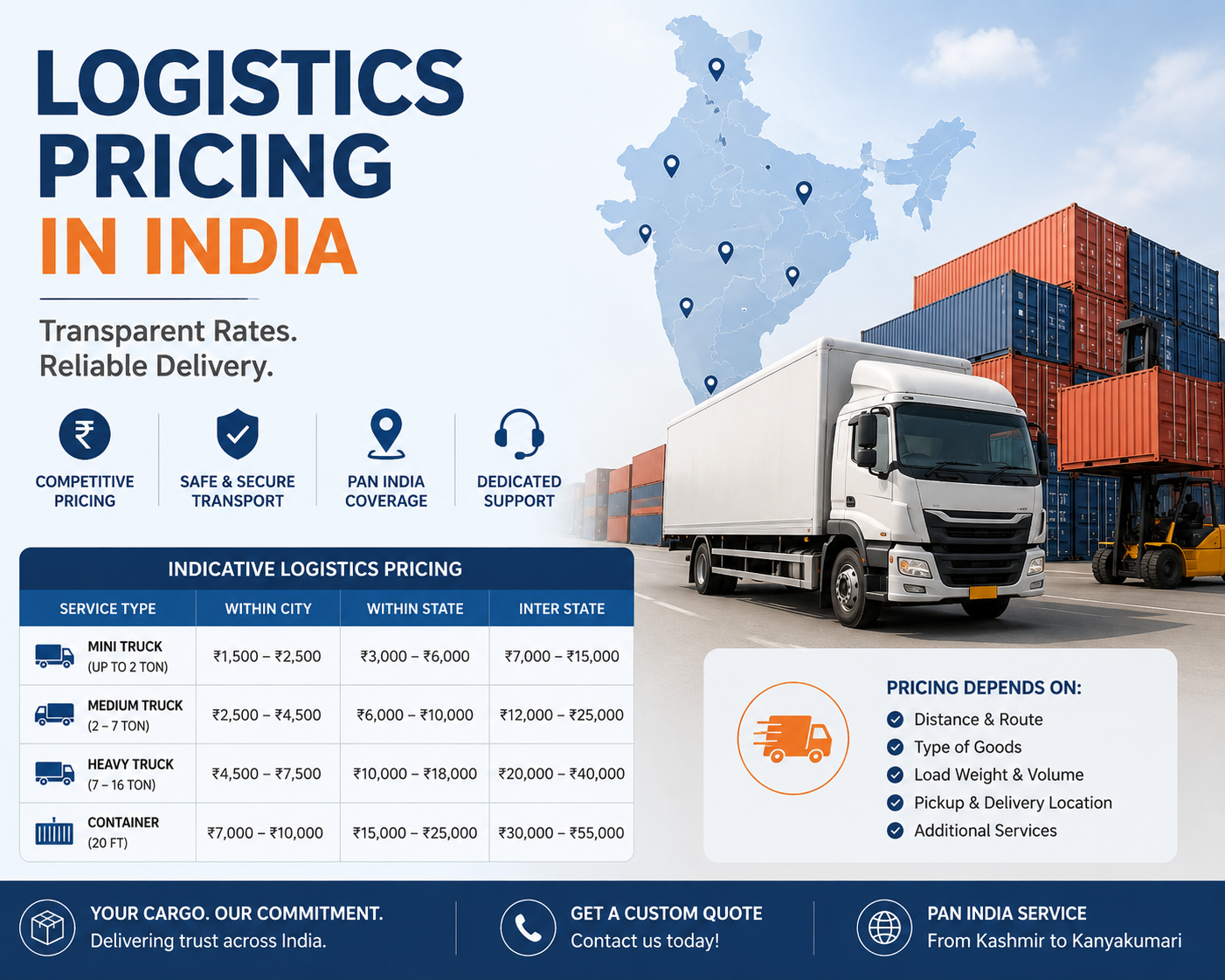
Before you can manage your freight costs, you need to understand how logistics pricing is structured. Indian transporters and logistics companies typically use one or more of the following pricing models:
1. Per Kilometre Pricing
This is the most straightforward model. The transporter charges a fixed rate per km travelled, regardless of cargo weight. It works well for FTL (Full Truck Load) bookings where you hire the entire vehicle.
Typical per km rates in India range from ₹18 to ₹60, depending on:
- Truck size and type (LCV, MCV, HCV, trailer)
- Route terrain (highway vs. hilly or rural roads)
- Return load availability on that route
2. Per Kg or Per Cubic Foot Pricing
PTL (Part Truck Load) and courier-style freight services usually charge per kg or per cubic foot — whichever is higher. This model is common in B2B logistics for smaller consignments.
Standard PTL rates across India typically fall between ₹3 and ₹15 per kg, based on commodity type, distance band, and service level.
3. Contract or Fixed-Rate Pricing
Many manufacturers, retailers, and e-commerce businesses negotiate fixed monthly or annual contracts with their logistics partner. This model offers rate stability and priority vehicle availability — especially valuable during peak demand periods when spot rates spike.
4. Project-Based Pricing (ODC and Special Cargo)
For Over-Dimensional Cargo (ODC) or project logistics — such as moving industrial machinery, transformers, or wind energy components — pricing is customised. It accounts for vehicle type, route survey, state permits, police escort, and transit time.
Key Factors That Affect Logistics Pricing in India
Logistics pricing does not exist in a vacuum. Several variables directly influence what you pay on every shipment. Understanding these helps you plan smarter and question unjustified rate increases.
Distance and Route Characteristics
Longer distances generally mean higher freight costs — but not always proportionally. A well-trafficked route like Mumbai–Delhi has more return loads, which keeps rates competitive. In contrast, a less-served corridor like Nagpur–Guwahati may carry a premium due to poor backload availability.
Cargo Type and Handling Requirements
Standard, non-fragile goods in regular packaging attract base rates. However, fragile items, hazardous materials, temperature-sensitive products, or irregularly shaped cargo require special equipment and handling — all of which add to the final logistics cost.
Vehicle Type and Load Capacity
The larger the vehicle, the higher the base rate — but the lower the per-unit cost once fully loaded. A 32-tonne truck carrying a full load from Chennai to Delhi is far more cost-efficient per tonne than sending four smaller vehicles on the same route.
Fuel Prices and Surcharges
Diesel price fluctuations directly impact freight rates across India. Most transporters apply a fuel surcharge that adjusts periodically. When diesel prices rise sharply — as they did in 2022 and again in 2024 — logistics pricing follows suit. Always check whether fuel surcharge is included or added separately in your quote.
Seasonal Demand and Market Conditions
Freight rates in India spike during:
- Festive seasons (September–November): Consumer goods, FMCG, and e-commerce volumes surge.
- Agricultural harvest periods (October–December and March–May): Produce and agri-commodity volumes peak.
- Financial year-end (February–March): Manufacturing and retail sectors rush to clear inventory.
Booking capacity in advance and working with a logistics partner who maintains a large fleet helps you avoid paying peak-season premiums.
FTL vs PTL Pricing — Which Is More Cost-Effective for Your Business?
Choosing between Full Truck Load and Part Truck Load significantly impacts your logistics pricing. Neither option is universally better — the right choice depends on your shipment size, urgency, and delivery requirements.
Full Truck Load (FTL) makes financial sense when:
- Your consignment weighs more than 5–7 tonnes
- You need direct, non-stop delivery
- Cargo is fragile or time-sensitive and cannot be consolidated
- You want to minimise handling and damage risk
Part Truck Load (PTL) is the smarter choice when:
- Your shipment is under 2,500 kg
- You can accept slightly longer transit times (due to hub consolidation)
- You ship regularly in smaller batches to multiple destinations
- You want to reduce per-shipment costs without booking a full vehicle
For many mid-sized businesses — manufacturers in Pune, distributors in Surat, or FMCG companies in Hyderabad — a combination of FTL for large orders and PTL for replenishment shipments delivers the best overall cost efficiency.
[Internal link suggestion: Explore Superior Transways’ FTL Services and PTL / Logistics Services for tailored pricing options.]
Smart Strategies to Reduce Your Logistics Costs in India
Cutting logistics costs does not mean choosing the cheapest transporter. It means making smarter decisions at every stage of your supply chain. Here are proven strategies:
- Consolidate Shipments: Instead of sending multiple small loads on different days, consolidate them into a single PTL or FTL booking. This reduces per-unit freight cost significantly.
- Negotiate Annual Contracts: If you ship regularly, lock in rates with a logistics partner through a fixed-rate contract. You get price stability and priority capacity — the provider gets guaranteed volume.
- Optimise Packaging: Dead weight and excess packaging inflate your chargeable weight in PTL shipments. Switching to compact, lightweight packaging materials directly lowers your per-kg freight cost.
- Use Hub-and-Spoke Networks: For PAN India distribution, routing shipments through strategically located logistics hubs (rather than direct city-to-city loads) often cuts costs by 15–25%.
- Track and Analyse Freight Data: Use real-time tracking data to identify delays, inefficiencies, and high-cost routes. Data-driven decisions help you renegotiate rates and improve delivery planning.
- Plan Ahead for Peak Seasons: Book your trucking capacity 2–3 weeks in advance during Diwali, harvest seasons, and March. Last-minute bookings during peak periods cost significantly more.
Why Choose Superior Transways for Transparent Logistics Pricing?
For over 15 years, Superior Transways — based in Vasai, Mumbai — has helped more than 4,000 businesses across India manage their logistics pricing with full transparency and zero surprises.
Here is what sets Superior Transways apart when it comes to fair, competitive freight pricing:
- No Hidden Charges: Every quote is fully itemised — base freight, fuel surcharge, tolls, and taxes are listed separately so you always know what you are paying for.
- PAN India Coverage: With operations across 25+ states, Superior Transways offers competitive rates on both high-volume corridors and less-served routes — reducing the premium you pay on difficult lanes.
- Full Service Portfolio: FTL, PTL, ODC Transportation, B2B Logistics, Bulk Transportation, Warehouse Services, and Tempo on Rent — all available under one roof, so you can consolidate vendors and negotiate better overall rates.
- Real-Time Tracking: Live shipment visibility means fewer calls, less uncertainty, and better delivery planning at your end — saving both time and money.
- 24/7 Support: A dedicated operations team is available round the clock to handle urgent bookings, re-routing, and escalations — so one missed truck does not derail your entire supply chain.
- Contract Pricing Options: For businesses with regular shipping volumes, Superior Transways offers customised contract rates that protect you from market volatility.
[Internal link suggestion: Contact us for a custom quote via our B2B Logistics page.]
FAQ — Logistics Pricing in India
Q1. How is logistics pricing calculated in India?
Logistics pricing in India is calculated based on distance, cargo weight or volume, vehicle type, route, fuel surcharges, and tolls. PTL shipments are typically priced per kg or per cubic foot. FTL bookings are usually quoted per km or as a fixed route rate. Additional charges like detention, multi-point delivery, and documentation may also apply depending on the service.
Q2. What is the average freight cost per kg in India?
For PTL shipments, average freight rates in India range from ₹3 to ₹15 per kg, depending on distance, commodity, and service type. Short-haul routes (under 300 km) within a state are at the lower end, while long-haul inter-state corridors — such as Delhi to Chennai — attract higher rates. Contract pricing with a regular logistics partner usually brings this cost down.
Q3. How can I reduce my logistics pricing without compromising quality?
The most effective strategies are: consolidating shipments to reduce per-unit cost, negotiating annual contract rates with a reliable transporter, optimising packaging to reduce chargeable weight, and booking capacity in advance during peak seasons. Working with a logistics partner that has a large PAN India fleet also gives you better rate options across more routes.
Q4. Why does logistics pricing in India vary so much between transporters?
Rate variation comes from differences in fleet quality, network coverage, return load availability, and service levels. Budget transporters often quote low upfront but add hidden charges at billing. Established logistics companies with large fleets can offer competitive rates on more routes due to better backload optimisation and economies of scale.
Q5. Is contract pricing better than spot pricing for freight in India?
For businesses that ship consistently — weekly or monthly — contract pricing almost always works out cheaper than booking at spot rates. Contracts give you rate certainty, priority vehicle allocation, and protection against seasonal spikes. Spot pricing works for one-off or irregular shipments, but it exposes you to market volatility, especially during peak demand periods.
Conclusion
Logistics pricing in India is complex — but it does not have to be confusing. When you understand the pricing models, know which variables drive costs up, and apply smart strategies to optimise your freight spend, you can take real control of one of your business’s biggest operational expenses.
The right logistics partner makes all the difference. Transparent rates, a reliable PAN India network, and consistent service quality are not luxuries — they are the baseline every business deserves.