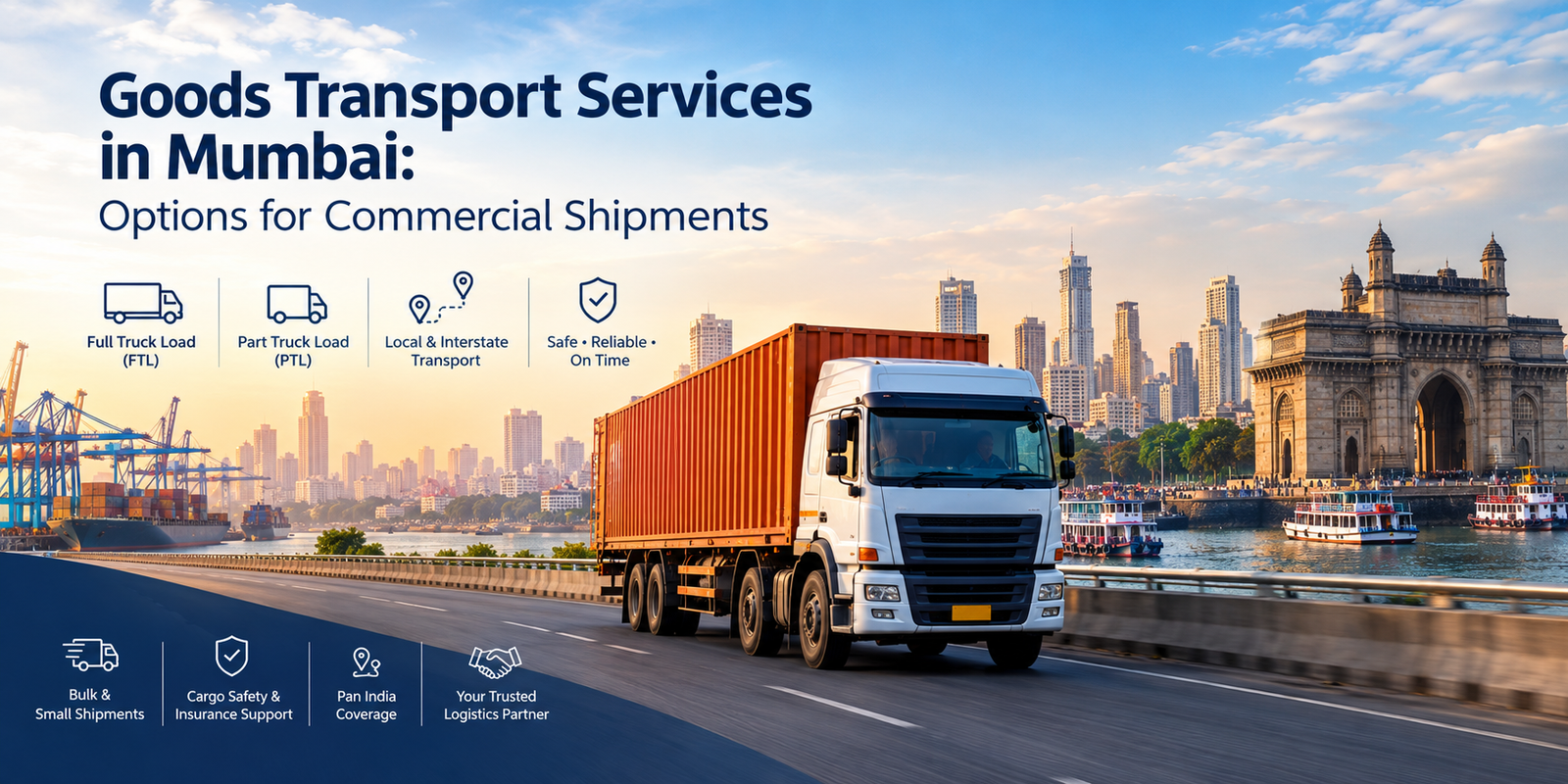
Mumbai is one of India’s major commercial centres, connecting manufacturers, wholesalers, distributors, retailers, importers, and exporters with markets across the country. From industrial goods and packaged products to machinery, raw materials, and wholesale inventory, businesses need dependable transportation to keep their supply chains moving.
Choosing the right Goods Transport Services in Mumbai can help businesses manage shipping costs, coordinate deliveries, protect commercial cargo, and maintain consistent supply to customers. However, not every shipment requires the same type of vehicle or transportation arrangement. Some businesses need an entire truck for bulk goods, while others need to transport smaller consignments without paying for unused vehicle capacity.
Understanding the available transport options helps businesses make informed decisions based on shipment size, destination, urgency, cargo type, and budget.
In this guide, we explain the different commercial goods transportation options available in Mumbai, how to select the right transport service, what affects freight charges, which documents may be required, and how Superior Transways can support businesses looking for transportation solutions from Mumbai to destinations across India.
What Are Goods Transport Services in Mumbai?
Goods transport services involve moving commercial products, materials, equipment, and other consignments from one location to another using suitable transportation vehicles and logistics arrangements.
For businesses operating in Mumbai, these services can include local transportation within the city, intercity truck transportation, interstate freight movement, full truck load services, part truck load services, and dedicated vehicle arrangements.
Depending on the transport provider and the shipment requirements, businesses may also arrange loading and unloading coordination, delivery scheduling, shipment documentation support, and status updates during transit.
For example, a manufacturer in Vasai may need to send finished products to a distributor in Ahmedabad. A wholesaler in Bhiwandi may require regular deliveries to retailers in Pune, while a machinery supplier in Mumbai may need to transport industrial equipment to a factory in another state.
Each shipment has different requirements. The most suitable transport arrangement depends on the cargo dimensions, weight, loading facilities, delivery deadline, and destination.
Superior Transways provides transport and logistics services for businesses requiring commercial goods movement from Mumbai to destinations across India. Businesses can discuss their shipment requirements and request a suitable transportation quotation.
Why Do Businesses Need Professional Goods Transport Services?
Commercial transportation is an important part of the supply chain. Even when a company manufactures or sells quality products, delayed deliveries and poor transportation coordination can affect customer satisfaction and business operations.
Here are several reasons why businesses use professional goods transportation services.
1. Reliable movement of commercial goods
Businesses often operate according to production schedules, dispatch commitments, and customer delivery deadlines. A well-coordinated transport arrangement helps businesses plan dispatches and communicate expected delivery timelines more effectively.
Before confirming a booking, discuss vehicle availability, pickup timing, destination, and the expected transit period with the transporter.
2. Access to suitable vehicles
Different goods require different vehicle capacities and configurations. A small commercial shipment may fit in a compact goods vehicle, whereas bulky industrial materials may require a larger truck.
Selecting a suitable vehicle helps businesses use available space efficiently while avoiding issues related to excessive weight, cargo dimensions, or loading requirements.
3. Better transportation cost management
Transportation expenses influence product pricing, distribution costs, and overall profitability.
Businesses can compare full truck load and part truck load options to determine which arrangement makes financial sense. For example, booking an entire truck for a small shipment may be unnecessary if a suitable part-load service is available for the required route and delivery schedule.
4. Easier coordination between suppliers and customers
A transport partner can help coordinate pickup details, delivery locations, vehicle arrangements, and communication between the consignor and consignee.
This is particularly useful for manufacturers and distributors handling regular dispatches to multiple cities.
5. Support for business expansion
As a business expands into new markets, it may need to transport goods beyond its immediate operating area.
A transport partner with suitable route coverage and vehicle sourcing capabilities can help businesses arrange deliveries to new destinations without independently managing every vehicle requirement.
Types of Goods Transport Services in Mumbai
The best transportation option depends on the quantity of goods, shipment frequency, delivery urgency, and budget. The following options are commonly considered for commercial shipments.
1. Full Truck Load (FTL) Transportation
Full Truck Load, commonly called FTL, involves booking a truck primarily for one customer’s shipment. The vehicle is assigned to carry that shipment rather than consolidating it with multiple customers’ consignments.
FTL is particularly useful for businesses transporting large quantities of goods or shipments requiring dedicated vehicle space.
Suitable for:
- Manufacturers dispatching bulk finished products.
- Distributors moving large quantities of inventory.
- Businesses transporting heavy or bulky goods.
- Industrial suppliers sending machinery or equipment.
- Companies with time-sensitive shipments that benefit from direct transportation.
Key advantages of FTL:
- Dedicated vehicle capacity.
- Potentially fewer cargo handling points.
- Better control over pickup and dispatch scheduling.
- Suitable for large or regularly recurring shipments.
- Direct transportation arrangements where the route and service permit.
FTL does not automatically guarantee a particular delivery time. Transit depends on the route, road conditions, vehicle availability, loading time, and other operational factors.
Businesses that regularly dispatch bulk goods can explore Full Truck Load Services in Mumbai to understand this option in more detail.
2. Part Truck Load (PTL) Transportation
Part Truck Load, also known as PTL, is suitable when a shipment does not require the capacity of an entire truck.
Under this arrangement, a customer’s cargo shares vehicle space with other compatible consignments, usually moving along a similar route or through a transport network.
The customer pays for the space or shipment capacity used, subject to the transporter’s pricing and minimum charges.
Suitable for:
- Small and medium-sized businesses.
- Wholesalers sending limited quantities of inventory.
- Distributors replenishing regional stock.
- Businesses shipping cartons, packages, or palletised products.
- Companies that do not have enough cargo to justify an entire truck.
Key advantages of PTL:
- Avoids paying for a full vehicle when it is unnecessary.
- Supports smaller commercial dispatches.
- Helps businesses send goods without waiting to accumulate a full truckload, depending on the service schedule.
- Can be useful for regular shipments of varying sizes.
However, part-load transportation may involve consolidation, intermediate handling, and longer transit times than a direct dedicated vehicle. Confirm the expected delivery window and handling arrangements before booking.
3. Local Goods Transportation Within Mumbai
Businesses often require vehicles to move goods between warehouses, factories, wholesale markets, retail outlets, and distribution centres within Mumbai and its surrounding commercial areas.
Local transportation can support factory dispatches, stock transfers, supplier deliveries, and movement of materials between business locations.
Typical requirements include:
- Moving inventory from a warehouse to a retail outlet.
- Transporting finished goods from a factory to a distribution centre.
- Collecting materials from a supplier.
- Shifting commercial stock between business premises.
- Delivering wholesale products to local customers.
For local shipments, consider vehicle size, loading access, delivery time restrictions, parking arrangements, and whether the pickup and delivery points allow the selected vehicle to enter.
Providing accurate pickup and delivery addresses helps the transporter select a more suitable vehicle and plan the trip.
4. Interstate Goods Transportation
Interstate transportation involves moving commercial cargo from Maharashtra to another state or bringing goods into Mumbai from another part of India.
This service is important for businesses serving customers beyond their local market.
Common commercial routes may include:
- Mumbai to Ahmedabad.
- Mumbai to Surat.
- Mumbai to Pune and other Maharashtra cities.
- Mumbai to Delhi.
- Mumbai to Bengaluru.
- Mumbai to Hyderabad.
- Mumbai to Chennai.
- Mumbai to Kolkata.
The availability of vehicles, transit times, and freight charges vary by route and shipment requirements.
Businesses should confirm the loading date, destination address, unloading arrangements, required documents, and expected delivery window before dispatch.
For companies planning regular interstate movements, working with a transport partner capable of coordinating suitable vehicles across multiple routes can simplify logistics planning.
5. Dedicated Commercial Vehicle Booking
Some shipments require a vehicle reserved for a specific business requirement, even when the shipment does not occupy every available cubic metre of the truck.
A dedicated vehicle can be useful when a customer needs greater control over dispatch timing, loading arrangements, or the transportation of sensitive or high-value commercial cargo.
Before confirming this option, discuss the vehicle type, route, delivery deadline, cargo handling requirements, and whether the vehicle will travel directly to the destination.
The final price depends on the agreed transport arrangement rather than cargo weight alone.
How to Choose the Right Goods Transport Service
Selecting the right service is not simply about finding the lowest quotation. Businesses should compare the total transportation arrangement, including suitability, scheduling, documentation, communication, and potential additional charges.
Step 1: Identify the shipment size
Start by recording the total weight, number of packages, dimensions, and approximate volume of the cargo.
For example, 100 cartons may require a different vehicle arrangement from a single heavy industrial machine, even if both shipments have similar weights.
Accurate dimensions help the transporter estimate the required loading space and identify any special handling requirements.
Step 2: Decide between FTL and PTL
Consider whether the cargo requires an entire truck or whether a part-load arrangement would be more economical.
FTL may be appropriate for bulk goods, large shipments, or consignments requiring a dedicated vehicle. PTL may suit smaller shipments that can share transport capacity.
Compare the total quotation, transit time, handling arrangements, and delivery commitments before deciding.
Step 3: Confirm the pickup and delivery locations
Provide the complete pickup and destination addresses, including PIN codes and relevant warehouse or factory details.
Also confirm whether loading and unloading facilities are available, whether a forklift or other equipment is needed, and whether the delivery location has restrictions on vehicle entry.
Step 4: Discuss the delivery schedule
If the goods are required for a production run, store opening, customer order, or scheduled dispatch, communicate the deadline before booking.
Ask the transporter for an estimated transit period and clarify whether the quotation includes any special scheduling requirements.
Avoid assuming that all routes have the same transit time or that a quoted delivery estimate is an unconditional guarantee.
Step 5: Check documentation and liability terms
Confirm which commercial documents are required, who will generate the applicable e-way bill, and what transport documentation will be supplied.
For valuable goods, clarify the cargo insurance arrangements, liability limitations, claims procedure, and any exclusions before dispatch.
Step 6: Compare quotations properly
When evaluating multiple transport providers, compare like-for-like quotations.
Check whether the quoted amount includes loading, unloading, tolls, detention, additional handling, applicable taxes, and other agreed charges.
A lower initial price may not represent the lowest total cost if important services are excluded.
Factors That Affect Goods Transport Charges in Mumbai
There is no single fixed price for every commercial shipment. Transport costs depend on several operational and commercial factors.
1. Distance and destination
Longer routes generally involve greater vehicle operating expenses. The actual quotation also depends on route conditions, tolls, availability of return loads, and demand for vehicles on the selected corridor.
2. Weight and cargo volume
A transporter may assess a shipment by its weight, the space it occupies, the vehicle capacity required, or a combination of these factors.
Bulky but lightweight goods can consume significant truck space, while compact and heavy cargo may be constrained by payload limits.
3. Vehicle type and capacity
A small goods vehicle, medium commercial truck, and large multi-axle vehicle have different operating costs and loading capacities.
The appropriate vehicle depends on cargo dimensions, weight distribution, loading equipment, route suitability, and legal restrictions.
4. FTL versus PTL
An FTL quotation generally covers the dedicated vehicle arrangement, whereas a PTL quotation may be calculated using shipment weight, volume, minimum charges, and other pricing rules.
Businesses should compare the total cost and service conditions rather than assuming that one option is always cheaper.
5. Loading, unloading, and handling
Charges may vary according to whether the customer provides labour, loading equipment, packaging, or unloading arrangements.
Heavy machinery, fragile cargo, and unusually shaped goods may require additional planning.
6. Urgency and scheduling
Urgent dispatches, after-hours loading, special pickup windows, or dedicated vehicle arrangements can affect the price.
Share the actual deadline so the transporter can recommend a realistic option.
7. Insurance and additional services
Cargo insurance, special packaging, extra handling, waiting time, and other agreed services may affect the final amount.
Always ask for a written quotation that explains the included services, exclusions, and applicable taxes.
Industries That Use Commercial Goods Transport Services
Mumbai’s commercial ecosystem includes businesses with very different transportation needs. Some require regular bulk dispatches, while others need occasional vehicle bookings.
Manufacturing and industrial businesses
Manufacturers transport raw materials, components, finished goods, and equipment between factories, suppliers, warehouses, and customers.
These businesses often benefit from planned vehicle allocation and dispatch coordination.
FMCG and packaged goods distributors
Fast-moving consumer goods distributors may need regular transportation of packaged products to warehouses, wholesalers, retailers, and regional distribution centres.
Shipment frequency, carton volume, stacking requirements, and delivery schedules influence vehicle selection.
Textile and garment businesses
Textile manufacturers, wholesalers, and garment distributors may move fabric rolls, finished clothing, accessories, and packaging materials.
The transport arrangement should account for cargo dimensions, protection against moisture and handling damage, and the destination’s unloading facilities.
Electronics and electrical goods suppliers
Electronics and electrical products may require careful handling and suitable packaging.
Businesses should communicate whether the cargo is fragile, unusually valuable, or subject to specific stacking restrictions before arranging transportation.
Machinery and equipment suppliers
Industrial machinery may have unusual dimensions, concentrated weight, or special loading requirements.
Vehicle selection should consider the cargo’s measurements, weight distribution, lifting points, loading equipment, and securing method.
Wholesale and trading businesses
Wholesalers frequently replenish stock across different locations and may send varying quantities to different customers.
FTL and PTL options can help these businesses match transportation capacity to the size and frequency of their orders.
Documents Required for Commercial Goods Transportation
Proper documentation helps reduce dispatch delays and supports compliance with applicable transport and tax requirements.
The documents required depend on the nature of the movement, the parties involved, the value of the consignment, and applicable regulations.
Commonly relevant documents include:
- Tax invoice, where applicable.
- Delivery challan or another appropriate document for the movement.
- E-way bill, when required under GST rules.
- Goods receipt or transport receipt.
- Consignor and consignee details.
- Vehicle and transporter details.
- Additional permits or cargo-specific documents, where applicable.
Understanding the GST e-way bill
Under Rule 138 of the Central Goods and Services Tax Rules, an e-way bill is generally required for covered movements of goods when the consignment value exceeds ₹50,000, subject to applicable provisions, exceptions, and notifications.
The consignor, consignee, or transporter may have responsibilities depending on how the movement is arranged and who generates the document.
Businesses should verify the current rules and their specific obligations before dispatch.
For official information, refer to the CBIC e-way bill rules and the GSTN e-way bill information.
Before the vehicle departs, check that the relevant invoice or challan, e-way bill where applicable, transporter information, and vehicle details are accurate.
How to Prepare Goods for Safe Transportation
Even when a suitable vehicle is arranged, correct preparation is essential for reducing the risk of damage.
Use suitable packaging
Choose packaging appropriate for the cargo’s weight, fragility, and exposure risks. Use strong cartons, pallets, protective wrapping, or crates when needed.
Label the consignments
Mark packages with relevant delivery information, package counts, and handling instructions. Labels such as “Fragile” or “This Side Up” should be used where appropriate, but labels do not replace proper physical protection.
Confirm cargo dimensions and weight
Provide accurate measurements and total weight before booking. Incorrect information may result in an unsuitable vehicle, loading problems, or revised charges.
Secure the load correctly
The cargo should be arranged and secured to prevent excessive movement during transit. Heavy items should be loaded with appropriate weight distribution, and stacking should follow the cargo’s limitations.
Photograph the cargo before dispatch
For valuable or damage-sensitive goods, consider recording the condition of the cargo and packaging before loading. Retain relevant invoices, shipment details, and delivery records.
Clarify insurance and claims
Do not assume that every transport booking includes comprehensive cargo insurance. Confirm whether insurance is arranged, what it covers, and how claims must be submitted.
These measures help establish clearer records and improve communication between the sender, transporter, and recipient.
Why Consider Superior Transways for Goods Transport Services in Mumbai?
Businesses need a transport partner that understands their shipment requirements and communicates clearly throughout the booking process.
Superior Transways provides transport and logistics services for customers arranging commercial goods movement from Mumbai to destinations across India.
When evaluating Superior Transways for your shipment, you can discuss the following requirements with the team:
- Suitable vehicle arrangements: Share your shipment size, weight, and dimensions to identify an appropriate vehicle.
- FTL transportation: Discuss dedicated truck requirements for bulk and larger commercial consignments.
- PTL or part-load requirements: Enquire about available part-load arrangements when your shipment does not need an entire truck.
- Route planning: Share your pickup and delivery locations to receive a quotation for your intended route.
- Dispatch coordination: Confirm pickup schedules, loading arrangements, documentation, and delivery expectations before the vehicle is dispatched.
- Commercial shipment requirements: Explain any special cargo handling, delivery timing, or recurring transport needs in advance.
The final service arrangement should be confirmed according to actual vehicle availability, route coverage, shipment specifications, and agreed commercial terms.
To learn more about the company’s transport offerings, visit Superior Transways.
How to Request a Goods Transport Quotation
Providing complete shipment information makes it easier for a transporter to evaluate the requirement and prepare a relevant quotation.
When contacting a transport provider, keep the following information ready:
- Pickup location: City, area, full address, and PIN code.
- Delivery location: Destination city, area, and PIN code.
- Goods description: Type of products or materials being transported.
- Shipment weight: Approximate total weight in kilograms or tonnes.
- Dimensions and package count: Number of cartons, pallets, crates, or individual items, including measurements where relevant.
- Vehicle requirement: Preferred vehicle type or whether you need the transporter to recommend one.
- Pickup date: The date on which the cargo will be ready for dispatch.
- Special requirements: Fragile cargo, heavy machinery, restricted stacking, loading equipment, or a particular delivery window.
You should also specify whether loading, unloading, insurance, and other additional services are required.
Need goods transport from Mumbai? Contact Superior Transways through its official website to discuss your shipment requirements and request a quotation. Providing complete details helps the team assess a suitable transportation arrangement for your business.
Frequently Asked Questions About Goods Transport Services in Mumbai
1. What are goods transport services in Mumbai?
Goods transport services in Mumbai help businesses move commercial products, raw materials, machinery, packaged goods, and other cargo within Mumbai or to destinations across India. Depending on the shipment, businesses can enquire about full truck load, part truck load, and other suitable commercial vehicle arrangements.
2. How do I choose a goods transport company in Mumbai?
Compare vehicle suitability, route coverage, expected transit time, pricing transparency, documentation support, communication, cargo liability terms, and insurance arrangements. Request a written quotation and confirm the service details before dispatch.
3. What is the difference between FTL and PTL transportation?
Full Truck Load (FTL) generally reserves an entire truck for one customer’s shipment. Part Truck Load (PTL) allows a shipment to share vehicle space with other compatible consignments. FTL may suit large or time-sensitive loads, while PTL can be useful for smaller shipments.
4. How much do goods transport services in Mumbai cost?
The price depends on the route, cargo weight and dimensions, vehicle type, shipment size, pickup schedule, handling requirements, and additional services. For an accurate quotation, provide the pickup and delivery locations along with complete shipment details.
5. Can I transport goods from Mumbai to other Indian states?
Yes, interstate goods transportation can be arranged for suitable routes, depending on vehicle availability and the transport provider’s service coverage. Confirm the destination, expected transit period, documentation requirements, and total charges before booking.
6. Which documents are required for commercial goods transportation?
Depending on the shipment, you may need an invoice, delivery challan, e-way bill where applicable, transport receipt, and relevant consignor, consignee, transporter, and vehicle details. Requirements depend on the nature and circumstances of the movement.
7. Is part-load transportation cheaper than full truck load?
Part-load transportation can be more economical for smaller consignments because you pay for a portion of the vehicle’s capacity rather than reserving the entire truck. The actual saving depends on minimum charges, shipment volume, route, handling, and delivery requirements.
8. How can I get a quotation from Superior Transways?
Visit the Superior Transways website and contact the company to discuss your requirements. Share the pickup and delivery addresses, cargo type, weight, dimensions, package count, and preferred dispatch date to help obtain a suitable quotation.
9. Can businesses arrange recurring goods transportation?
Businesses with regular dispatches can discuss recurring transportation requirements with a suitable transport provider. Share expected shipment frequency, routes, approximate cargo volumes, and delivery schedules so that an appropriate arrangement can be evaluated.
10. What should I check before sending commercial goods?
Verify the vehicle type, cargo dimensions, packaging, pickup and delivery details, written quotation, relevant documents, insurance and liability terms, and expected delivery period. Keep dispatch records and communicate special handling requirements before loading.
Conclusion
Choosing the right Goods Transport Services in Mumbai can help businesses manage commercial shipments more efficiently, control transportation costs, and serve customers across different markets.
The best option depends on your cargo type, shipment size, destination, urgency, and budget. Full Truck Load services can be appropriate for bulk consignments requiring dedicated vehicle capacity, while Part Truck Load services can provide an alternative for smaller shipments. Local and interstate transportation options support businesses with different distribution requirements.
Before booking, compare quotations, confirm the vehicle and delivery arrangements, prepare the necessary documents, and ensure that the cargo is packaged and secured appropriately.
If your business needs commercial goods transportation from Mumbai to destinations across India, Superior Transways can be a starting point for discussing your route and shipment requirements.
Visit superiortransways.com to learn more and enquire about transportation services for your business.