B2B vs B2C Logistics: Key Differences Explained
Introduction
Choosing the right logistics model can significantly impact your business growth, customer satisfaction, and overall operational efficiency. Understanding B2B vs B2C Logistics is essential for manufacturers, wholesalers, retailers, distributors, and e-commerce businesses operating across India. While both logistics models involve transporting goods from one place to another, they differ greatly in shipment size, delivery speed, customer expectations, and operational processes.
For example, a manufacturer shipping industrial machinery from Mumbai to Pune follows a completely different logistics approach than an online retailer delivering a mobile phone to a customer in Delhi. Each model requires specialized planning, transportation methods, warehouse management, and tracking systems.
In this guide, you’ll learn the major differences between B2B vs B2C Logistics, their advantages, real-world Indian examples, and how choosing the right logistics partner can improve your supply chain performance while reducing transportation costs.
What is B2B Logistics?
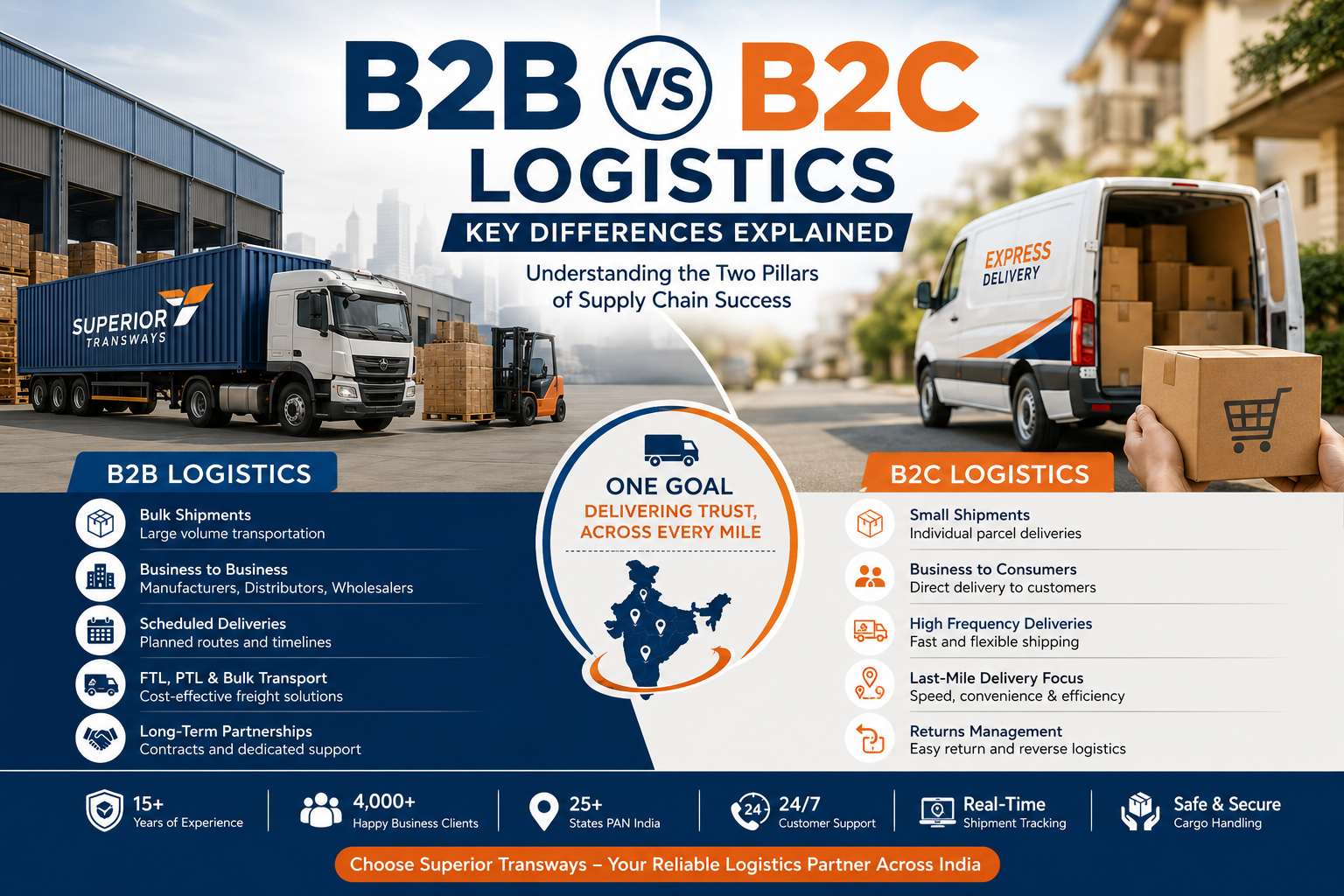
Business-to-Business (B2B) logistics refers to the transportation of goods between businesses instead of individual consumers. These shipments usually involve manufacturers, distributors, wholesalers, suppliers, retailers, and industrial clients.
Unlike consumer deliveries, B2B logistics focuses on larger shipments, scheduled deliveries, and long-term business relationships.
Characteristics of B2B Logistics
- Large shipment volumes
- Bulk transportation using FTL and PTL services
- Scheduled deliveries
- Lower delivery frequency
- Contract-based logistics
- Warehouse integration
- Inventory management support
For example, an automobile manufacturer in Pune regularly ships engine components to an assembly plant in Chennai. Similarly, pharmaceutical companies transport medicines from manufacturing units in Gujarat to distributors across India using organized freight networks.
Since businesses rely on uninterrupted production and inventory availability, B2B logistics prioritizes reliability, cost optimization, and on-time deliveries.
What is B2C Logistics?
Business-to-Consumer (B2C) logistics focuses on delivering products directly to end customers. This logistics model has grown rapidly due to India’s booming e-commerce industry.
Unlike B2B shipments, B2C logistics involves handling thousands of small orders daily across multiple cities and towns.
Characteristics of B2C Logistics
- Small package deliveries
- High delivery frequency
- Last-mile delivery focus
- Faster shipping expectations
- Easy returns management
- Customer communication and notifications
- Flexible delivery schedules
For instance, when a customer orders clothing from an online marketplace, the logistics provider picks, packs, ships, and delivers the product directly to the customer’s doorstep.
Because customer satisfaction directly affects repeat purchases, B2C logistics emphasizes speed, visibility, and delivery convenience.
B2B vs B2C Logistics: Major Differences
Although both logistics models aim to move products efficiently, their operational requirements are significantly different.
| Factor | B2B Logistics | B2C Logistics |
|---|---|---|
| Customers | Businesses | Individual consumers |
| Shipment Size | Large and bulk | Small parcels |
| Delivery Frequency | Scheduled | High volume daily |
| Delivery Speed | Planned | Fast and flexible |
| Transportation | FTL, PTL, Bulk Transport | Courier and parcel services |
| Order Value | High | Lower |
| Customer Expectations | Accuracy and reliability | Speed and convenience |
| Returns | Limited | Frequent |
In India, manufacturing companies usually depend on B2B logistics services for regular transportation between factories, warehouses, and distributors. On the other hand, online retailers rely on B2C logistics to meet customer delivery expectations in metropolitan cities and remote locations alike.
Understanding these differences helps businesses select the most efficient logistics strategy for their operations.
Challenges in B2B and B2C Logistics
Every logistics model comes with unique operational challenges.
Common B2B Logistics Challenges
- Managing large freight volumes
- Coordinating deliveries across multiple warehouses
- Maintaining inventory accuracy
- Reducing transportation costs
- Ensuring on-time deliveries
Common B2C Logistics Challenges
- Last-mile delivery delays
- High return rates
- Peak season demand
- Customer delivery expectations
- Delivery address accuracy
Indian businesses often experience transportation delays due to traffic congestion, seasonal weather conditions, or regional infrastructure differences. Therefore, selecting a logistics provider with extensive network coverage and real-time shipment tracking becomes essential for maintaining supply chain efficiency.
Choosing the Right Logistics Model for Your Business
Selecting between B2B and B2C logistics depends on your business model, customer base, and shipping requirements.
Choose B2B logistics if you:
- Supply products to distributors
- Manufacture industrial goods
- Ship in bulk
- Require warehouse integration
- Need regular transportation schedules
Choose B2C logistics if you:
- Sell directly to consumers
- Operate an e-commerce business
- Handle frequent small orders
- Require doorstep delivery
- Need reverse logistics support
Many growing businesses combine both models. For example, a furniture manufacturer may ship bulk orders to retailers while simultaneously fulfilling direct online customer orders.
A flexible logistics partner can support both transportation requirements efficiently.
Why Choose Superior Transways for B2B Logistics?
When businesses need dependable transportation across India, choosing an experienced logistics partner makes all the difference.
Superior Transways, headquartered in Vasai, Mumbai, has been providing reliable logistics and transport solutions for over 15 years. The company serves more than 4,000 business clients across 25+ Indian states, making it a trusted partner for manufacturers, retailers, distributors, and industrial businesses.
Key advantages include:
- PAN India transportation network
- Full Truck Load (FTL) services
- Part Truck Load (PTL) services
- B2B logistics expertise
- ODC transportation
- Bulk transportation solutions
- Warehouse services
- Tempo on Rent
- Real-time shipment tracking
- Safe cargo handling
- Dedicated customer support
- 24/7 logistics assistance
Whether your business requires scheduled freight movement, warehouse distribution, or nationwide transportation, Superior Transways offers scalable logistics solutions designed for operational efficiency and timely deliveries.
Suggested Internal Links:
- https://superiortransways.com/b2b-logistics
- https://superiortransways.com/ftl-services
- https://superiortransways.com/logistics-services
Frequently Asked Questions (FAQs)
1. What is the main difference between B2B vs B2C Logistics?
The biggest difference is the customer type. B2B logistics transports goods between businesses in bulk, while B2C logistics delivers products directly to individual customers in smaller quantities with faster delivery expectations.
2. Which logistics model is better for manufacturers?
Manufacturers generally benefit from B2B logistics because it supports bulk transportation, scheduled deliveries, warehouse integration, and cost-effective freight management across multiple business locations.
3. Why is B2B logistics important in India?
B2B logistics helps manufacturers, wholesalers, and retailers maintain uninterrupted supply chains. Efficient transportation reduces operational costs, improves inventory availability, and ensures timely deliveries across India’s diverse markets.
4. What transportation services are commonly used in B2B logistics?
Businesses commonly use Full Truck Load (FTL), Part Truck Load (PTL), bulk transportation, warehouse services, and specialized ODC transportation depending on shipment size and cargo requirements.
5. How can Superior Transways help businesses?
Superior Transways provides PAN India logistics services including FTL, PTL, warehouse services, ODC transportation, B2B logistics, bulk transportation, and real-time shipment tracking backed by over 15 years of industry experience.
Conclusion
Understanding B2B vs B2C Logistics helps businesses build an efficient supply chain while improving customer satisfaction and reducing transportation costs. Although B2B logistics focuses on bulk business shipments and long-term operational efficiency, B2C logistics prioritizes speed, flexibility, and customer convenience. Selecting the right logistics strategy—and the right logistics partner—can directly impact your business performance.
If you’re looking for reliable, cost-effective, and scalable logistics solutions across India, Superior Transways is ready to help. With a strong PAN India network, 15+ years of experience, over 4,000 satisfied business clients, advanced tracking technology, and 24/7 customer support, the company delivers dependable transportation solutions tailored to your business needs.