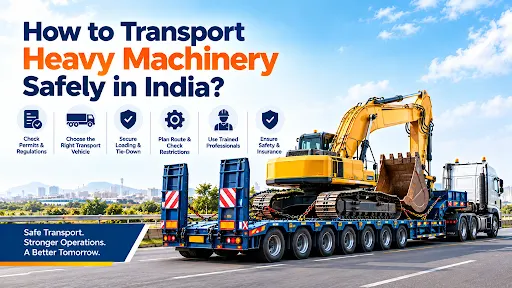
How to Transport Heavy Machinery Safely in India?
Quick Summary:
Moving big factory machines across Indian roads needs low-bed trailers, strong steel chains, and smart route checks. Shippers must measure machine height and total weight before booking trucks. Getting state RTO road papers stops police fines and long road delays. Planning every step to Transport Heavy Machinery keeps equipment safe from flipping over on highways.
Transport Heavy Machinery Basic Safety Steps
Safety starts by picking low-bed hydraulic trucks that match your machine weight. Workers drain extra fuel and oil from machine tanks so nothing spills during long road trips. Drivers check truck tyre air and brake pads before loading big machines onto trailer beds.
Following clear steps to Transport Heavy Machinery stops road flips and keeps drivers safe.
Transport Heavy Machinery Vehicle and Trailer Selection
Primary Trailer Types for Industrial Cargo
- Low-bed trailers carry tall diggers easily under low road bridges.
- Multi-axle hydraulic trucks move giant factory machines weighing over 40 tons.
- Flatbed trucks carry long steel pipes and iron frames safely down highways.
- Semi-low bed trucks haul medium farm tractors and road rollers between cities.
| Trailer Model | Weight Capacity | Deck Height | Primary Equipment Cargo |
| Low-Bed Trailer | 20 – 40 Tons | 2.5 – 3.5 Feet | Diggers, bulldozers, cranes |
| Multi-Axle Hydraulic | 40 – 150 Tons | Adjustable | Power plant turbines, transformers |
| Flatbed Trailer | 15 – 30 Tons | 4.5 – 5.0 Feet | Steel beams, large boilers, rollers |
Transport Heavy Machinery Step-by-Step Loading Steps
Clean the trailer deck to remove slick oil or loose dirt before driving machines up metal ramps. Operators drive equipment slowly onto the middle of the trailer deck to balance total machine weight across all wheels.
Workers pull parking handbrakes tight and place thick rubber blocks against every tyre or track wheel.
Taking time to Transport Heavy Machinery correctly stops heavy items from sliding during fast highway stops.
Step-by-Step Loading Checklist
- Place thick wooden blocks under trailer ramps for floor support.
- Drive machines up loading ramps using low engine speed.
- Center machine weight right over the truck wheel groups.
- Set machine parking brakes and turn off main power switches.
- Put steel wheel blocks behind every tyre or track link.
Transport Heavy Machinery Trailer Stacking vs Tiedown Methods
Comparison of Cargo Security Techniques
| Security Parameter | Steel Chain Tiedowns | Synthetic Web Straps |
| Weight Capacity | Holds heavy iron loads over 10 tons | Holds lighter machine parts under 3 tons |
| Sharp Edge Risk | Resists cut damage from sharp metal corners | Cuts easily on sharp steel edges |
| Stretch Control | Zero stretch on bumpy highway roads | Stretches under heavy rain or sun heat |
Transport Heavy Machinery Legal Permits and RTO Rules
State RTO laws need special paper permits for extra-wide cargo moving on public roads. Moving giant plant machines needs police escort cars driving ahead of big trucks.
Drivers keep printed permits, scale weight slips, and tax e-waybill papers inside truck cabs for road checks.
Getting road papers to Transport Heavy Machinery stops heavy police fines and truck holds.
Required Transit Documents
- State RTO wide-load cargo paper permits.
- Scale weight slips showing axle weight numbers.
- GST e-waybills with matching truck plate numbers.
- Transit insurance sheets covering machine damage.
- Route clearance letters for low bridge areas.
Transport Heavy Machinery Common Mistakes on Highways
Shippers often use thin ropes instead of thick steel chains to lock heavy metal machines down. Drivers skip checking roads first, leading to trucks getting stuck under low power wires or narrow bridges.
Forgetting to tighten chains after driving the first 50 kilometers causes loose loads on rough roads.
Avoiding simple mistakes to Transport Heavy Machinery keeps expensive factory items safe from bad crashes.
Errors to Avoid During Transit
- Using thin cloth straps on heavy sharp metal equipment.
- Skipping road checks for low overhead bridges before driving.
- Forgetting to tighten chain clamps after starting the trip.
- Loading single truck wheels past legal RTO weight limits.
Transport Heavy Machinery Route Planning and Obstacle Checks
Road survey workers drive chosen highways first to check overhead bridges, road widths, and hanging wires. Drivers pick wider main highways to skip narrow village streets and weak wooden bridges.
Planning side roads avoids sudden traffic jams in crowded city areas.
Careful route planning to Transport Heavy Machinery gets items to factory gates right on time.
Transport Heavy Machinery Tiedown Standards and Chain Maintenance
Use thick steel chains to lock heavy machines onto trailer hook points. Workers attach chains at four separate corner points using hand tighteners to pull steel lines tight.
Check chain links for rust, cracks, or bent pins before clamping them onto machine frames.
Following strict rules to Transport Heavy Machinery holds heavy items tight during sharp road turns.
Chain Lashing Rules
- Hook four separate chains at corner angles to trailer hooks.
- Use hand ratchet clamps instead of simple lever bars for safety.
- Place rubber edge pads between steel chains and machine paint.
- Re-tighten all chain clamps every 100 kilometers during trips.
Transport Heavy Machinery Weather Protection and Tarping
Cover machine engines and electric boxes with thick plastic sheets before starting road trips. Tie plastic sheets down tight with extra ropes so highway wind does not rip plastic away.
Apply anti-rust oil coatings on bare metal parts during rainy monsoon season moves.
Protecting equipment while you Transport Heavy Machinery keeps inner machine parts clean and dry.
Transport Heavy Machinery Professional Carrier Selection
Hiring expert transport companies brings trained drivers and well-kept hydraulic trucks for your cargo. Specialized road carriers have full insurance plans to cover accidental damage losses.
Expert road teams handle paper permits, driver shifts, and live location updates easily.
Choosing good teams to Transport Heavy Machinery keeps your factory work moving without problems.
📞 Call Superior Transways for reliable heavy equipment transport and expert trailer booking today!
Follow Superior Transways on Facebook and Instagram for truck booking tips, freight transport updates, logistics insights, and smarter ways to move your goods safely!
Looking for reliable goods transportation solutions? Choose Superior Transways for a trusted Transport Company in Mumbai, dependable Full Truck Load Services in Mumbai, and efficient transport solutions across Navi Mumbai, Bhiwandi, and Vasai. Get reliable Transport Company in Navi Mumbai services, Full Truck Load Services in Navi Mumbai, Transport Company in Bhiwandi services, Full Truck Load Services in Bhiwandi, Transport Company in Vasai services, and Full Truck Load Services in Vasai. We also offer convenient Tempo on Rent in Mumbai, Tempo on Rent in Navi Mumbai, Tempo on Rent in Bhiwandi, and Tempo on Rent in Vasai for your business transportation needs. Contact Superior Transways to discuss your requirements.
Frequently Asked Questions
What trailer type works best for moving tall industrial excavators safely?
Low-bed trailers work best because low deck heights keep total machine height under highway bridge limits.
How many steel chains do you need to secure a 20-ton machine onto a trailer?
Use at least four independent grade-70 steel chains clamped at four separate deck corners for heavy loads.
Do you need special RTO permits to move over-dimensional heavy machinery in India?
Yes, moving extra-wide or over-weight machinery requires special RTO permits and route approval papers.
Why should drivers re-check chain tension after driving the first 50 kilometers?
Road vibration causes heavy machines to settle, making steel chains go loose on early highway miles.
Need help? Call us +91 777-002-614 Superior Transways your order and experience the difference in your snacks! 📞