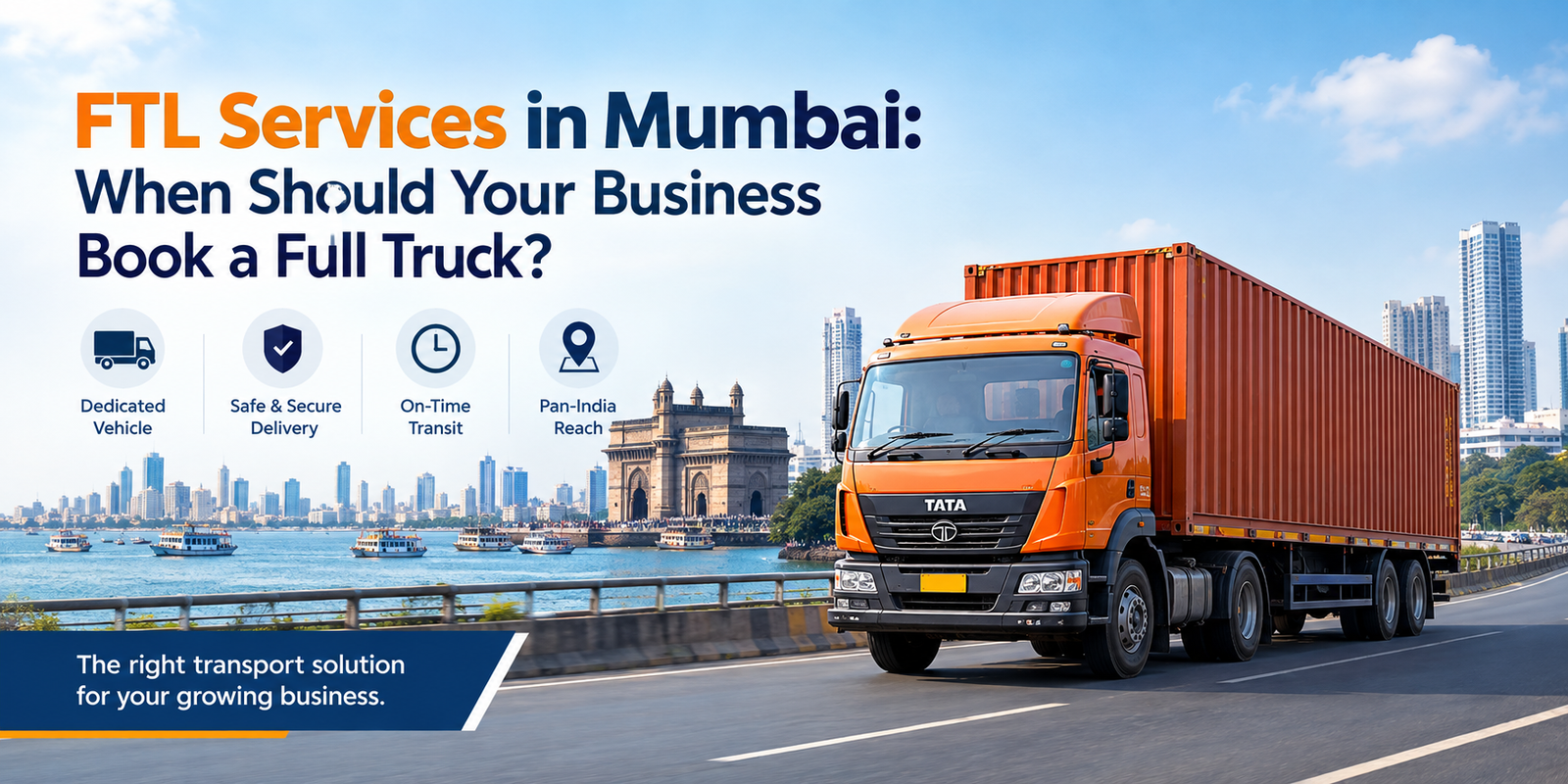
Mumbai is one of India’s important commercial and logistics centres, connecting manufacturers, wholesalers, distributors, importers, exporters, and retailers with markets across Maharashtra and the rest of the country. Businesses operating in Mumbai, Navi Mumbai, Bhiwandi, Thane, and Vasai often need dependable transportation to move inventory, raw materials, machinery, and finished products.
However, choosing the right transportation option is not always straightforward. Should you book an entire truck, share vehicle space with other businesses, or split your shipment into smaller consignments? The answer depends on your cargo volume, delivery schedule, budget, handling requirements, and destination.
FTL Services in Mumbai can be an appropriate solution when your business needs dedicated vehicle capacity, direct transportation, or greater control over a commercial shipment. Full Truck Load (FTL) transport allows a truck to be assigned to one customer’s shipment instead of consolidating it with unrelated consignments.
But booking a full truck for every shipment is not necessarily economical. Understanding when FTL makes sense can help you manage transport expenses, minimise unnecessary handling, and plan deliveries more effectively.
In this guide, we explain what FTL transportation means, when businesses should book a full truck, how it compares with Part Truck Load (PTL), what influences pricing, and how to prepare a shipment for transport from Mumbai.
What Are FTL Services in Mumbai?
FTL stands for Full Truck Load. It is a road transportation arrangement in which a truck is dedicated to a single customer’s shipment for a planned movement.
Unlike shared-load transportation, where multiple customers’ consignments occupy the same vehicle, FTL allocates the vehicle’s capacity to one shipment or customer movement. The cargo is transported according to the agreed pickup, route, and delivery arrangements.
A shipment does not necessarily have to fill every available centimetre of the truck to qualify for FTL. A business may book a dedicated vehicle because its cargo is bulky, fragile, time-sensitive, difficult to consolidate, or requires a specific loading arrangement.
For example, a manufacturer in Bhiwandi may need to transport a large quantity of packaged products to a distributor in Ahmedabad. Instead of sending the goods through a shared-load network, the business could arrange a dedicated truck to carry the shipment directly to the destination, subject to the agreed service and route.
Why do Mumbai businesses use FTL transportation?
Mumbai’s commercial ecosystem includes manufacturing units, distribution centres, wholesale markets, warehouses, and port-related businesses. These operations frequently need transportation that aligns with production and inventory schedules.
FTL transportation can be useful for:
Manufacturers dispatching finished goods to distributors.
Wholesalers replenishing inventory at regional warehouses.
Importers moving commercial cargo from designated collection points.
Retail businesses transferring large quantities of stock.
Industrial suppliers transporting machinery and equipment.
Companies sending recurring shipments between cities.
Businesses with cargo that should not be combined with unrelated goods.
For suitable shipments, dedicated truck capacity can simplify dispatch coordination and reduce intermediate handling. However, actual transit time, vehicle suitability, and delivery commitments should always be confirmed with the transport provider before booking.
7 Situations When Your Business Should Book a Full Truck
Not every business needs FTL transportation every day. The following situations can help you determine when booking a dedicated vehicle is worth considering.
1. Your shipment occupies a substantial amount of truck space
One of the clearest reasons to consider FTL is shipment size.
If your consignment occupies most of the usable loading space in a suitable vehicle, paying for shared transportation may not provide meaningful savings. A dedicated truck can make better commercial sense, particularly when the cargo is ready for dispatch and needs to move as one shipment.
Consider a distributor in Mumbai sending a large order of packaged consumer goods to a warehouse in Pune. If the consignment occupies most of the available space in a suitable truck, FTL may provide a practical way to move the entire order together.
However, do not judge truck requirements on volume alone. Weight limits, dimensions, axle-load restrictions, packaging, and loading arrangements also matter.
When to book: Your shipment is large enough that a dedicated truck is competitive with the total cost of alternative arrangements.
2. Your goods must reach the destination within a planned delivery window
Some commercial shipments are linked to production deadlines, distributor commitments, store replenishment schedules, or warehouse receiving appointments.
In these situations, additional collection and delivery stops associated with shared-load transport may make planning more complicated.
FTL can provide a more direct movement plan because the vehicle is assigned to your shipment rather than multiple unrelated consignments.
For example, a Mumbai-based manufacturer dispatching products to a customer in Surat may need the goods to arrive before a scheduled unloading window. A dedicated truck can make coordination easier, provided the transporter confirms a realistic transit plan.
Remember that FTL does not automatically guarantee same-day delivery or a fixed arrival time. Traffic, weather, road restrictions, loading delays, and route conditions can affect actual transit.
When to book: Your shipment has a firm receiving appointment, a production deadline, or a delivery schedule that benefits from dedicated transportation.
3. You want to minimise cargo handling
Every time goods are transferred, rearranged, or handled during transportation, there is an opportunity for packaging damage, misplacement, or loading errors.
FTL can reduce the need for intermediate consolidation and transfers when the shipment travels directly from pickup to destination. This can be particularly valuable for fragile, bulky, carefully packed, or high-value commercial goods.
Examples include:
Electrical equipment and industrial components.
Furniture and large retail products.
Packaged machinery and spare parts.
Bulk cartons that should remain together.
Goods with special stacking or orientation requirements.
Reduced handling does not eliminate the possibility of damage. Proper packaging, vehicle selection, load securing, and careful loading and unloading remain essential.
When to book: Your cargo is sensitive to handling or needs to remain together throughout the journey.
4. You are dispatching bulk orders to distributors or warehouses
Businesses that sell through dealers, wholesalers, distributors, or regional fulfilment centres often send large consignments in planned batches.
Booking a full truck can help coordinate these movements by keeping a bulk order together and aligning vehicle placement with warehouse receiving arrangements.
For example, a textile supplier operating in Bhiwandi may dispatch a large consignment of fabric to a customer in another state. If the shipment is ready as one batch, a dedicated vehicle may simplify loading, documentation, dispatch, and delivery coordination.
This approach is also worth evaluating when several smaller orders can be combined into one properly planned shipment for a single destination.
When to book: You have a bulk dispatch, a consolidated distributor order, or recurring warehouse replenishment requirements.
5. Your cargo is bulky, heavy, or difficult to consolidate
A shipment can require a dedicated vehicle even when it is not particularly heavy.
Large crates, long industrial components, oversized equipment, or goods that cannot be stacked may occupy significant space. They can also be difficult to combine safely with other customers’ cargo.
When evaluating such shipments, consider:
Length, width, and height of each package.
Total shipment weight and the weight of the heaviest item.
Whether packages can be stacked.
Whether the goods require an open-body or closed-body vehicle.
Whether loading from the rear, side, or top is necessary.
Whether a forklift, crane, or other equipment is required.
For example, an industrial equipment supplier may have several large crates that occupy most of a truck’s loading area but weigh less than its maximum payload. A dedicated vehicle may still be the appropriate option.
When to book: Cargo dimensions, weight distribution, stacking restrictions, or loading requirements make shared transportation difficult.
6. You need a dedicated vehicle for a recurring transport route
Businesses with predictable shipment patterns can benefit from planning their transportation in advance.
Suppose your company regularly dispatches goods from Mumbai to Ahmedabad, Pune, Indore, or Delhi. If your shipment volume is consistent, discussing recurring FTL arrangements with a transport provider may help you plan vehicle requirements and dispatch schedules.
Recurring arrangements can also make it easier to establish standard operating procedures for:
Vehicle placement and reporting time.
Loading and dispatch documentation.
Delivery coordination.
Proof of delivery collection.
Shipment status updates.
Freight billing and payment terms.
A recurring arrangement does not automatically guarantee a fixed price or vehicle availability. Both should be agreed upon according to the route, demand, and service conditions.
When to book: Your business has repeat shipments on established routes and can forecast dispatch volumes.
7. Your shipment requires a dedicated transport arrangement
Certain shipments are better suited to a dedicated vehicle because of their handling requirements, segregation needs, or operational constraints.
For example, a business may want one vehicle for a specific purchase order, a large customer dispatch, or a shipment that should not be mixed with other cargo.
Dedicated transportation can simplify responsibility for the shipment and reduce the complexity of coordinating multiple consignments.
For regulated, hazardous, temperature-sensitive, or otherwise specialised goods, confirm that the transporter, vehicle, equipment, permits, and operating procedures meet the applicable requirements. Standard FTL service should not be assumed to cover every specialised cargo category.
When to book: The shipment needs dedicated capacity or operational conditions that are difficult to meet through shared transportation.
FTL vs PTL: Which Transportation Option Is Better?
Before booking FTL Services in Mumbai, compare Full Truck Load with Part Truck Load transportation. The best option depends on the shipment rather than simply the distance travelled.
FTL reserves a truck for your shipment, while PTL allows your goods to share vehicle capacity with other compatible consignments.
| Comparison factor | FTL transportation | PTL transportation |
|---|---|---|
| Vehicle allocation | Dedicated to one customer’s shipment | Shared with other consignments |
| Shipment size | Often suitable for large or bulky loads | Often suitable for smaller loads |
| Transit planning | Can allow more direct routing | May involve consolidation and additional stops |
| Cargo handling | Can reduce intermediate transfers | May involve additional handling |
| Pricing | Based on dedicated vehicle and movement requirements | Based on shipment space, weight, route, and pricing rules |
| Delivery scheduling | Easier to plan around one shipment | Depends partly on consolidation and network schedules |
| Best suited for | Bulk dispatches and dedicated movements | Smaller shipments that can share capacity |
Is FTL always cheaper than PTL?
No. FTL may be more economical per carton, pallet, tonne, or unit when the shipment occupies a substantial proportion of a suitable truck. But a small shipment can cost considerably more per unit when it requires a dedicated vehicle.
To make a fair comparison, calculate the total landed transportation cost rather than comparing only the quoted freight rate.
Include potential expenses associated with handling, storage, additional deliveries, missed receiving windows, and inventory delays where relevant.
For instance, a wholesaler transporting 100 cartons may find PTL more practical if the goods can travel with other consignments. A manufacturer dispatching several tonnes of finished products to one destination may find FTL more suitable.
You can explore the Full Truck Load Services in Mumbai guide for more information about dedicated truck transportation.
Which Industries Should Consider FTL Services in Mumbai?
FTL is useful across several commercial sectors, but the ideal arrangement depends on the cargo and delivery requirements.
Manufacturing and engineering
Manufacturers regularly move raw materials, components, finished products, and industrial equipment between factories, warehouses, and customers.
FTL can help coordinate bulk dispatches, particularly when the shipment is large or requires dedicated loading arrangements.
FMCG and retail distribution
Fast-moving consumer goods businesses often need to replenish regional warehouses, wholesalers, and retail distribution points.
A full truck may be appropriate when a large order needs to be transported to one destination. Businesses should coordinate the dispatch schedule with the receiving warehouse to avoid unnecessary waiting.
Textile and garment businesses
Mumbai and nearby commercial areas have substantial textile trading and distribution activity. Businesses moving fabric rolls, packaged garments, and bulk textile inventory can consider FTL when shipment volume or handling requirements justify a dedicated vehicle.
Electronics and electrical equipment
Businesses transporting electrical equipment, appliances, or sensitive components may prefer dedicated vehicle capacity to reduce intermediate handling and keep a shipment together.
Appropriate packaging, load securing, weather protection, and any special transport conditions should be confirmed before dispatch.
Machinery and industrial supplies
Large equipment, machine parts, metal components, and industrial supplies can have unusual dimensions or weight distributions.
For these shipments, selecting a vehicle based on cargo measurements and loading requirements is especially important. Oversized cargo may need additional planning, permissions, or specialised equipment.
Importers, exporters, and wholesale distributors
Businesses moving cargo between warehouses, collection points, and domestic distribution locations may benefit from FTL when they have a bulk consignment ready to move.
Port-related or container movements may require a different vehicle arrangement from standard road freight, so the exact requirement should be clarified when requesting a quote.
How to Book FTL Services in Mumbai: Step-by-Step Process
Booking a full truck is easier when you provide accurate shipment details from the beginning. A clear transport brief helps the provider assess vehicle suitability, route feasibility, pricing, and delivery expectations.
Step 1: Prepare your cargo details
Record the commodity type, package count, total weight, dimensions, and any stacking or handling restrictions. Mention whether the goods are palletised, crated, loose, or packaged in cartons.
Step 2: Confirm pickup and delivery locations
Share the complete pickup and delivery addresses, including PIN codes, site access conditions, contact persons, and any restrictions on truck entry. This is important for warehouses and industrial facilities.
Step 3: Select the appropriate vehicle
Discuss the required body type, usable loading dimensions, payload capacity, and loading method. A vehicle should be selected based on both cargo weight and volume, not length alone.
Step 4: Request a detailed freight quotation
Ask for the freight charge, applicable tolls or additional charges, loading and unloading responsibilities, waiting charges, payment terms, and any applicable taxes. Confirm the final quotation in writing.
Step 5: Confirm the booking and dispatch schedule
Finalise the vehicle placement time, loading window, dispatch date, expected transit time, delivery contact, and any special instructions. Do not treat a preliminary estimate as a confirmed booking.
Step 6: Complete documentation and track the shipment
Prepare the applicable invoice, e-way bill where required, and transport documentation. Obtain vehicle and driver details, agree on status-update arrangements, and collect proof of delivery after unloading.
What Factors Affect FTL Transportation Costs in Mumbai?
There is no single FTL price that applies to every shipment. A reliable quote depends on the route, vehicle, cargo, and operational requirements.
1. Distance and destination
The origin and destination influence fuel consumption, tolls, route feasibility, and vehicle utilisation. A shipment from Mumbai to Pune will have different cost considerations from a long-distance movement to Delhi or Bengaluru.
2. Truck type and capacity
Different shipments require different vehicles. Vehicle size, payload, body type, and availability can influence the freight quote.
Selecting a truck that is unnecessarily large or unsuitable for the cargo can increase costs or create operational problems.
3. Cargo weight and dimensions
Both weight and volume affect vehicle selection. Bulky but lightweight cargo may occupy most of the loading area without approaching the maximum payload.
Share accurate measurements so the transport provider can assess the most suitable option.
4. Pickup and delivery conditions
Restricted access, loading delays, warehouse appointments, labour requirements, and special unloading arrangements can affect the overall transportation cost.
Inform the provider about these requirements before confirming the booking.
5. Timing and vehicle availability
Urgent dispatches, seasonal demand, and limited availability on a particular route may affect pricing. Advance planning can provide more time to compare suitable vehicles and quotations, although it does not guarantee a lower rate.
6. Additional services and cargo requirements
Specialised equipment, particular vehicle body types, cargo insurance arrangements, or additional handling requirements may involve extra costs.
Ask the provider to clarify which services are included and which will be billed separately.
Practical tip: Request an itemised quotation that clearly specifies the agreed route, vehicle, freight, additional charges, taxes, payment terms, and expected delivery window. Comparing quotations on the same basis is more useful than choosing the lowest headline price.
How to Choose the Right FTL Transport Company in Mumbai
Selecting a transport provider involves more than comparing freight quotations. Your logistics partner should understand your cargo, route, documentation requirements, and delivery expectations.
Before booking, consider these factors.
Route experience: Ask whether the provider can arrange transportation on your required route and destination.
Vehicle suitability: Confirm the vehicle’s dimensions, payload, body type, and loading arrangements.
Transparent pricing: Request a written quotation that identifies included services and additional charges.
Communication: Establish how you will receive vehicle placement details and shipment status updates.
Documentation: Confirm responsibility for invoices, applicable e-way bills, transport receipts, and proof of delivery.
Cargo protection: Discuss packaging, load securing, insurance requirements, and procedures for reporting damage.
Delivery coordination: Confirm the expected transit window and arrangements for delays or unloading issues.
For more guidance, read the guide to choosing the right transport company in Mumbai.
Why Consider Superior Transways for FTL Services in Mumbai?
Superior Transways provides a relevant starting point for businesses looking to discuss commercial transportation requirements from Mumbai.
Whether you are a manufacturer, wholesaler, distributor, or industrial supplier, the first step is to explain your shipment clearly so the appropriate transportation option can be assessed.
When enquiring about FTL Services in Mumbai, share the following information:
Pickup and delivery locations.
Type of goods and number of packages.
Total cargo weight and dimensions.
Preferred truck type, if known.
Expected loading date and delivery window.
Any special handling or documentation requirements.
You can visit Superior Transways or explore its Full Truck Load Services in Mumbai page to discuss your transport requirements.
Vehicle availability, route feasibility, freight charges, and delivery commitments should be confirmed for each individual shipment before booking.
Frequently Asked Questions About FTL Services in Mumbai
1. What are FTL Services in Mumbai?
FTL Services in Mumbai involve arranging a dedicated truck for one customer’s shipment. They are commonly used to transport bulk goods, industrial materials, finished products, and large commercial consignments from Mumbai to destinations within Maharashtra and other Indian states.
2. When should my business book a full truck?
Consider booking FTL when your shipment occupies substantial truck space, requires dedicated vehicle capacity, contains bulky or sensitive goods, or needs a planned direct movement. Compare the total cost with PTL before making a decision.
3. Is FTL better than PTL transportation?
Neither option is universally better. FTL can suit large shipments and dedicated movements, while PTL may be more economical for smaller consignments that can share vehicle space. The right choice depends on shipment size, urgency, handling requirements, and budget.
4. Can I book FTL if my goods do not fill the entire truck?
Yes. A truck can be booked exclusively for your shipment even if the vehicle is not completely full. This may be appropriate when cargo dimensions, handling requirements, or delivery arrangements justify a dedicated vehicle. The commercial viability should be assessed before booking.
5. How much do FTL Services in Mumbai cost?
The price depends on the pickup and delivery locations, distance, vehicle type, cargo weight and dimensions, loading arrangements, timing, and additional services. Contact a transport provider with complete shipment details to obtain an accurate quotation.
6. Which vehicle should I book for full truck transportation?
The appropriate vehicle depends on cargo dimensions, weight, packaging, loading method, and delivery conditions. A small commercial vehicle may suit a compact shipment, while larger consignments may require a higher-capacity truck. Always confirm usable loading space and permitted payload.
7. Can I arrange full truck transportation from Mumbai to other states?
FTL transportation can be arranged for suitable interstate routes, subject to vehicle availability, service coverage, and applicable requirements. Confirm the destination, estimated transit period, documentation, and charges with the provider.
8. What documents are required for FTL transportation?
Depending on the transaction and goods, documentation may include a commercial invoice, delivery challan where applicable, e-way bill when required, and transport receipt or consignment note. Additional permits or documents may be necessary for particular cargo categories. Confirm the requirements before dispatch.
9. Does FTL guarantee faster delivery?
Not automatically. Dedicated transportation can reduce delays associated with consolidation and additional stops, but road conditions, traffic, vehicle availability, loading time, and other operational factors still affect delivery. Confirm a realistic transit estimate before booking.
10. How can I request an FTL quotation from Mumbai?
Prepare your pickup and delivery addresses, cargo description, total weight, dimensions, package count, preferred dispatch date, and any special requirements. Share these details with Superior Transways through its website to discuss your transportation needs.
Conclusion: When Is Booking a Full Truck the Right Decision?
Booking a full truck is a strategic transportation decision that should be based on shipment size, delivery requirements, cargo characteristics, and total logistics cost.
For businesses operating in Mumbai, Navi Mumbai, Bhiwandi, Thane, and Vasai, FTL can be a practical option for bulk dispatches, distributor replenishment, industrial cargo, recurring routes, and shipments that benefit from dedicated vehicle capacity.
However, smaller shipments with flexible delivery schedules may be better suited to PTL transportation. Evaluating both options helps businesses avoid unnecessary freight expenses while maintaining effective delivery planning.
If your company regularly moves commercial goods, prepare your shipment details, compare suitable vehicle options, and request a transparent quotation before confirming a booking.
Looking for FTL Services in Mumbai? Visit Superior Transways to discuss your full truck load transportation requirements.