Complete Guide to FTL vs LTL Transport in India (2026)
Introduction
Choosing the right transportation model can significantly impact your business costs, delivery timelines, and customer satisfaction. Many Indian businesses struggle with a common question: should they use Full Truck Load (FTL) or Less Than Truck Load (LTL) transportation?
Understanding FTL vs LTL Transport in India is essential for manufacturers, distributors, retailers, and supply chain managers who regularly move goods across cities and states. Selecting the wrong option can lead to higher transportation costs, delayed deliveries, and inefficient logistics operations.
For example, a manufacturer in Mumbai shipping a full consignment to Delhi may benefit from FTL services, while a retailer sending smaller shipments to multiple locations may find LTL more economical.
In this comprehensive guide, we will explain the differences between FTL and LTL transportation, compare costs and benefits, discuss ideal use cases, and help you determine the best option for your business in 2026.
What is FTL Transport?
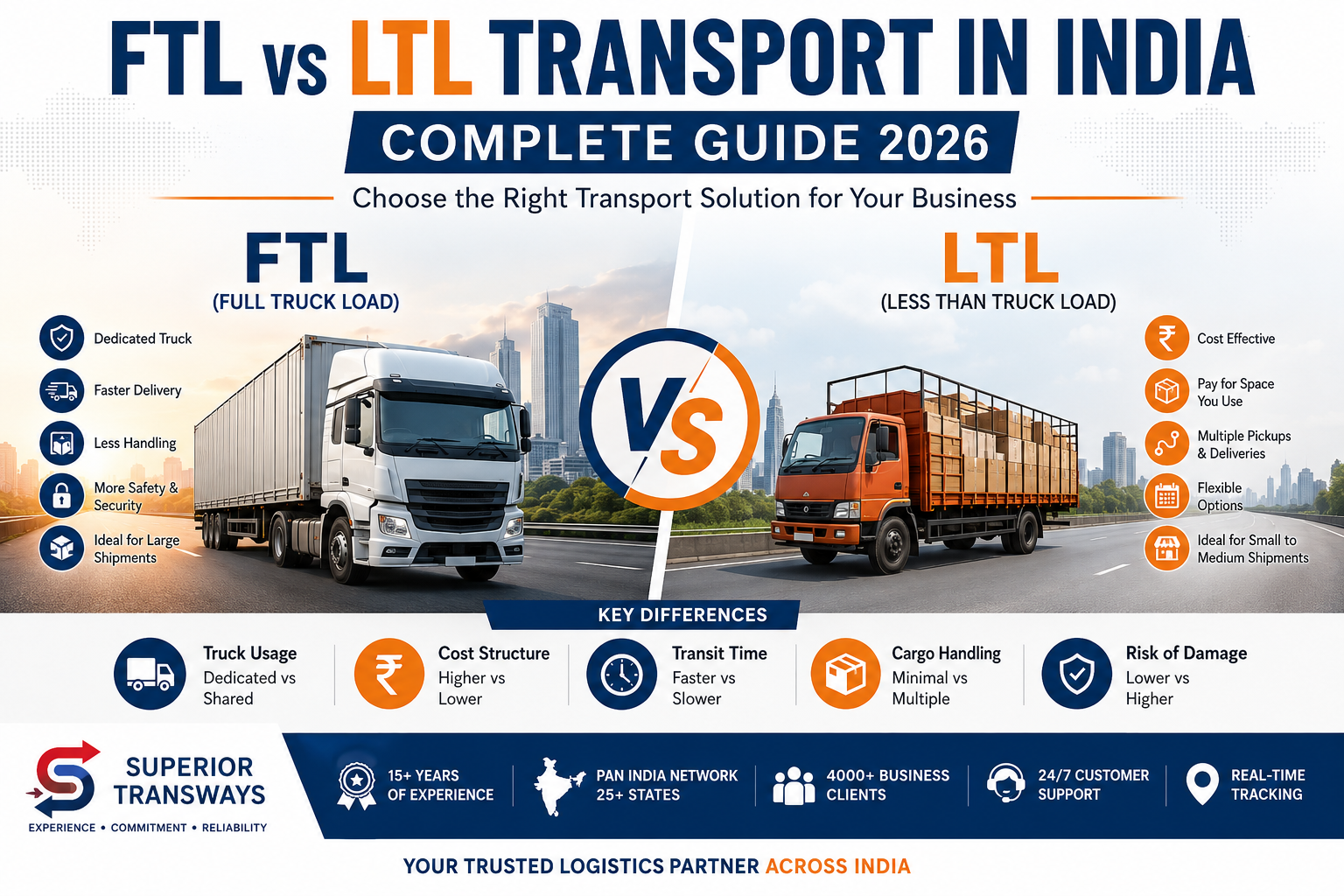
FTL (Full Truck Load) transportation refers to a shipment that occupies an entire truck. In this model, a single customer books the complete vehicle for transporting goods from origin to destination.
How FTL Works
The truck is dedicated exclusively to one shipper. Once loaded, the vehicle travels directly to the destination without making multiple stops for other customers’ cargo.
Benefits of FTL Transport
- Faster transit times
- Reduced handling of goods
- Lower risk of damage
- Better shipment security
- Ideal for large-volume consignments
For instance, an automotive manufacturer in Pune shipping spare parts to Chennai may choose FTL because the cargo volume fills an entire truck.
Industries Commonly Using FTL
- Automobile manufacturing
- FMCG distribution
- Construction materials
- Industrial equipment
- Pharmaceutical bulk movement
Businesses that require time-sensitive deliveries often prefer Full Truck Load Services because they provide greater control and reliability.
What is LTL Transport?
LTL (Less Than Truck Load), commonly called PTL (Part Truck Load) in India, allows multiple businesses to share truck space. Each shipper pays only for the space their cargo occupies.
How LTL Works
A logistics provider consolidates shipments from different customers into a single vehicle. The truck may stop at multiple locations for loading and unloading.
Benefits of LTL Transport
- Lower transportation costs
- Better for small shipments
- Flexible shipping volumes
- Reduced logistics expenses
- Suitable for regular dispatches
For example, a retailer in Ahmedabad sending 500 kg of products to Bengaluru does not need an entire truck. LTL becomes a cost-effective solution.
Industries Commonly Using LTL
- E-commerce businesses
- Retail chains
- SMEs
- Consumer goods distributors
- Electronics suppliers
Part Truck Load Services help businesses optimize transportation spending while maintaining delivery efficiency.
FTL vs LTL Transport in India – Key Differences
Understanding the core differences between FTL and LTL transportation helps businesses make informed logistics decisions.
| Factor | FTL Transport | LTL Transport |
|---|---|---|
| Truck Usage | Entire truck dedicated | Shared truck space |
| Cost Structure | Fixed vehicle cost | Pay for used space |
| Transit Time | Faster | Slower |
| Cargo Handling | Minimal | Multiple touchpoints |
| Risk of Damage | Lower | Higher |
| Shipment Size | Large volume | Small to medium volume |
| Tracking Visibility | Higher | Moderate |
| Delivery Priority | Direct route | Multi-stop route |
When to Choose FTL
Choose FTL when:
- Shipment volume exceeds 8–10 tons
- Goods are fragile or high-value
- Fast delivery is critical
- Cargo fills most of the truck
When to Choose LTL
Choose LTL when:
- Shipment volume is small
- Cost optimization is a priority
- Delivery timelines are flexible
- Regular small shipments are required
Businesses evaluating FTL vs LTL Transport in India should balance cost, speed, and shipment volume before deciding.
Cost Comparison of FTL and LTL Transportation
Transportation cost remains one of the most important decision factors for businesses.
FTL Cost Structure
FTL pricing is generally based on:
- Vehicle type
- Distance traveled
- Fuel costs
- Toll charges
- Route complexity
Even if the truck is partially filled, the customer pays for the complete vehicle.
LTL Cost Structure
LTL pricing depends on:
- Weight
- Cargo dimensions
- Volume occupied
- Delivery destination
- Handling requirements
Because costs are shared among multiple shippers, LTL often becomes more economical for smaller consignments.
Real-World Example
Imagine a business shipping goods from Mumbai to Hyderabad:
FTL Option
- Entire truck booked
- Faster delivery
- Higher overall cost
LTL Option
- Shared truck space
- Lower cost
- Longer transit time
Therefore, businesses should calculate both direct transportation costs and indirect costs such as inventory carrying expenses before making a decision.
Which Option is Better for Your Business?
The answer depends on your logistics requirements.
Choose FTL If:
- You transport large quantities regularly.
- Delivery speed matters.
- Cargo safety is a priority.
- You serve manufacturing or industrial sectors.
Choose LTL If:
- You have smaller shipments.
- Budget control is important.
- You ship frequently in smaller quantities.
- You operate an SME or retail business.
Decision Checklist
Ask these questions:
- How much cargo am I shipping?
- What is my delivery deadline?
- Is cargo damage a major concern?
- What is my transportation budget?
- How often do I ship goods?
By evaluating these factors, businesses can confidently choose between FTL and LTL transportation models.
Why Choose Superior Transways?
When selecting a logistics partner, experience and network coverage matter as much as pricing.
Superior Transways has established itself as a trusted logistics company serving businesses across India.
What Makes Superior Transways Different?
- PAN India network covering 25+ states
- 15+ years of logistics expertise
- 4,000+ satisfied business clients
- 24/7 customer support
- Real-time shipment tracking
- Safe cargo handling practices
- Dedicated fleet for FTL transportation
- Reliable PTL and B2B logistics solutions
- Warehousing and distribution support
Based in Vasai, Mumbai, Superior Transways helps businesses streamline supply chains and reduce transportation challenges across India.
For businesses requiring dedicated vehicle movement, consider the internal service page:
Suggested Internal Link: /ftl-services
Businesses seeking end-to-end supply chain support can also explore:
Suggested Internal Link: /b2b-logistics
Frequently Asked Questions (FAQs)
What is the difference between FTL and LTL transport?
FTL uses an entire truck for one customer’s shipment, while LTL combines cargo from multiple customers in a shared vehicle. FTL offers faster delivery and better security, whereas LTL provides cost savings for smaller shipments.
Is FTL cheaper than LTL?
Not necessarily. FTL is generally more expensive for small shipments because you pay for the full truck. However, for large-volume cargo, FTL often provides better value and lower cost per unit transported.
Which industries benefit most from FTL transportation?
Industries such as manufacturing, automotive, pharmaceuticals, FMCG, and construction frequently use Full Truck Load Services because they transport large quantities and require timely deliveries.
Is LTL suitable for small businesses?
Yes. LTL transportation is ideal for SMEs and retailers that ship smaller quantities. It allows businesses to reduce freight expenses by paying only for the space used.
How do I choose between FTL and LTL?
Consider shipment volume, delivery urgency, cargo value, handling requirements, and transportation budget. Businesses with large or time-sensitive shipments typically benefit from FTL, while smaller shipments often suit LTL.
Conclusion
Understanding FTL vs LTL Transport in India is essential for optimizing transportation costs and improving supply chain efficiency. FTL offers faster transit, dedicated vehicles, and enhanced cargo safety, while LTL provides cost-effective solutions for smaller shipments.
The right choice depends on your shipment size, delivery requirements, and business goals. By evaluating these factors carefully, companies can improve logistics performance and reduce overall transportation costs.
If you’re looking for reliable FTL, PTL, warehousing, or B2B logistics solutions across India, contact Superior Transways today. With 15+ years of experience, a network spanning 25+ states, and 4,000+ business clients, the company delivers dependable logistics support tailored to your business needs.