FTL vs PTL — Which Freight Model Is Right for Your Business in India?
Picture this: your factory in Pune has 8 tonnes of finished goods ready to ship to a distributor in Delhi. Do you book a full truck? Or share space with other consignments? Make the wrong call and you’re either overpaying for unused truck capacity — or watching your cargo arrive late, damaged, or misdirected. This decision comes down to one of the most important choices in Indian freight logistics: FTL vs PTL.
Full Truck Load (FTL) and Part Truck Load (PTL) are the two primary freight models used by businesses across India. Each has its own cost structure, transit timeline, risk profile, and ideal use case. Yet many business owners and supply chain managers pick one without fully understanding the difference — and end up paying the price.
In this guide, we break down FTL vs PTL in detail. You’ll learn how each model works, when to use which, how costs compare, and what factors should drive your decision. By the end, you’ll have a clear framework to make smarter freight choices every time.
What Is FTL (Full Truck Load)?
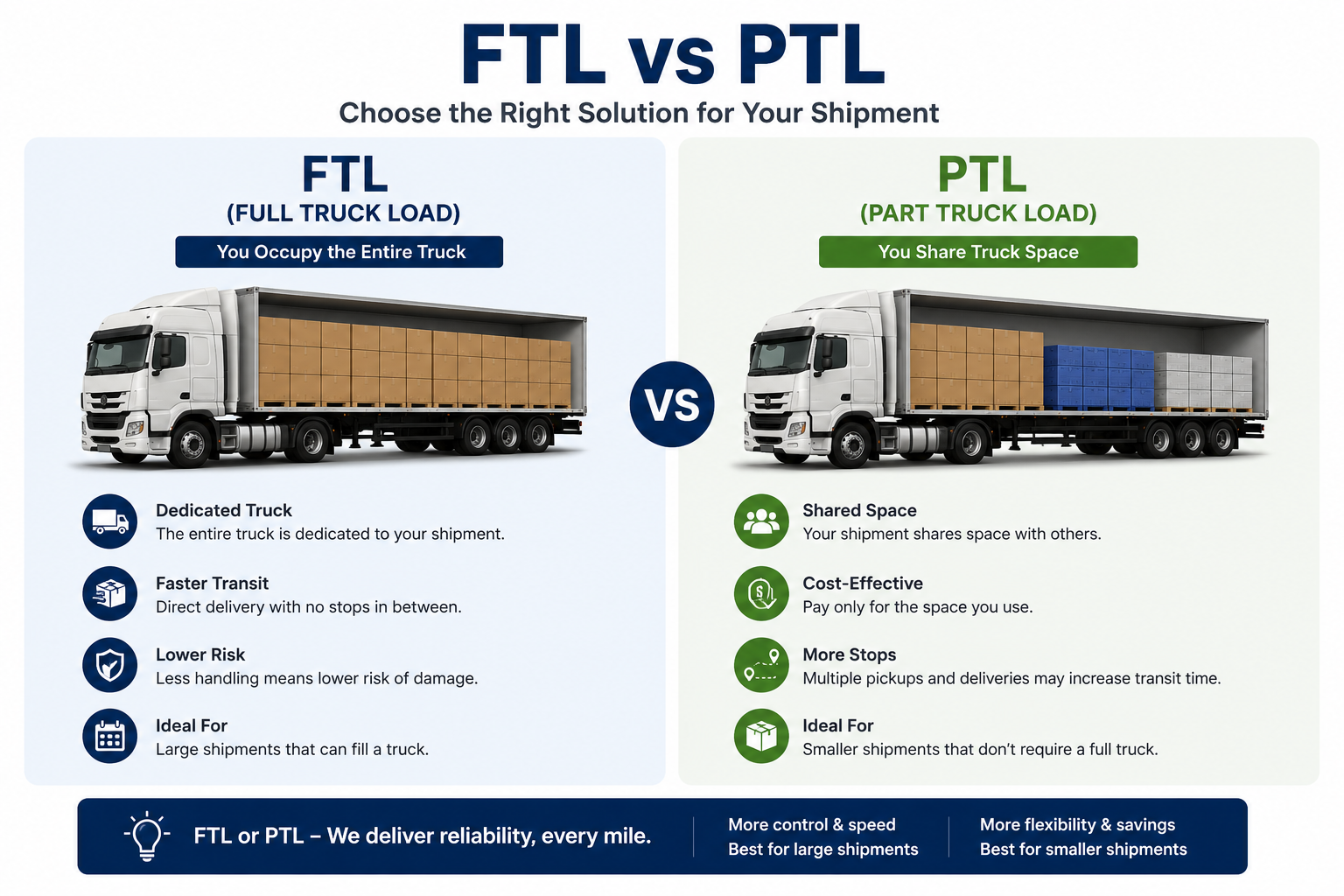
FTL, or Full Truck Load, is a freight model where a single business books an entire truck exclusively for its own cargo. The truck moves directly from the pickup point to the delivery destination — no shared space, no intermediate stops for other consignments.
Key Characteristics of FTL
- Exclusive truck use — 100% of the truck capacity is yours
- Direct routing — no loading or unloading stops for other shipments
- Faster transit times — fewer delays between origin and destination
- Lower handling risk — your cargo isn’t moved multiple times in transit
- Scalable capacity — trucks range from 1-tonne tempos to 40-feet trailers carrying 25+ tonnes
FTL is the preferred model for manufacturers, wholesalers, and retailers who regularly ship large volumes of goods. Think of a steel manufacturer in Raipur dispatching coils to an automobile plant in Chennai — the load fills an entire trailer, the goods are sensitive to mishandling, and on-time arrival is critical. FTL is the natural fit.
It’s also the only practical option for ODC (Over Dimensional Cargo) — heavy machinery, industrial equipment, and oversized goods that can’t share space by their very nature.
In short, FTL gives you maximum control, speed, and cargo safety. The trade-off is cost — you pay for the full truck regardless of how much of it you use.
What Is PTL (Part Truck Load)?
PTL, or Part Truck Load — also called LTL (Less Than Truck Load) or groupage freight — is a shared freight model. Multiple shippers book portions of the same truck. The transporter consolidates several smaller consignments into one vehicle and delivers them across multiple stops.
Key Characteristics of PTL
- Shared truck capacity — you pay only for the space your cargo occupies
- Multiple stops in transit — the truck serves several shippers on the same route
- Lower per-trip cost — ideal for smaller, irregular, or non-urgent shipments
- More handling touchpoints — cargo is loaded, unloaded, and transferred at hubs
- Longer transit times — consolidation and multiple stops add time to delivery
PTL works well for small businesses, retailers, and e-commerce sellers who ship smaller quantities more frequently. For example, a pharmaceutical distributor in Mumbai sending 500 kg of medicines to a clinic in Nagpur doesn’t need a full truck — PTL lets them ship cost-effectively without paying for 20 tonnes of unused space.
However, the shared nature of PTL means your goods are handled more often. Each transfer point introduces a small risk of damage, delay, or mix-up — especially for fragile or high-value items.
FTL vs PTL — A Side-by-Side Comparison
Here’s a direct comparison to help you evaluate both models quickly:
| Factor | FTL (Full Truck Load) | PTL (Part Truck Load) |
|---|---|---|
| Truck Usage | Entire truck for one shipper | Truck shared by multiple shippers |
| Cost Structure | Higher per trip; lower cost per kg | Lower per trip; higher cost per kg |
| Transit Time | Fast — direct routing | Slower — multiple stops and consolidation |
| Cargo Handling | Minimal — loaded once, unloaded once | Multiple touchpoints at hubs |
| Damage Risk | Low | Moderate to higher |
| Best Cargo Volume | Large shipments (typically 10+ tonnes) | Smaller shipments (below 5–8 tonnes) |
| Delivery Predictability | High — fixed route and timeline | Moderate — depends on consolidation |
| Ideal For | Manufacturers, bulk shippers, ODC cargo | SMEs, retailers, e-commerce sellers |
| Flexibility | Lower — full truck commitment | Higher — ship smaller quantities anytime |
The right choice depends on your cargo volume, urgency, budget, and sensitivity of goods. Neither model is universally better — they serve different business needs.
When Should You Choose FTL Over PTL?
Choosing between FTL vs PTL isn’t just about volume — it’s about total cost of logistics, cargo safety, and business priorities.
Choose FTL When:
- Your shipment weighs 10 tonnes or more, or fills over 70% of a standard truck
- Your goods are fragile, high-value, or time-sensitive — electronics, pharmaceuticals, glassware
- You need guaranteed delivery windows for supply chain or retail deadlines
- You’re shipping hazardous or regulated materials requiring dedicated handling
- You’re moving ODC cargo — machinery, construction equipment, large industrial parts
- You want full real-time visibility without cargo changing hands at multiple hubs
- You ship regularly on fixed lanes — factory to warehouse, warehouse to distributor
Choose PTL When:
- Your shipment is small or irregular — under 5 tonnes or a few pallets
- You don’t have fixed shipping schedules and ship on an ad-hoc basis
- Cost per trip matters more than speed or exclusivity
- Your goods are non-fragile and non-urgent — dry goods, stationery, general merchandise
- You’re an SME or startup building freight volume before committing to FTL contracts
A practical example: an FMCG company in Ahmedabad shipping a full truckload of packaged food to a Delhi distribution centre every week should use FTL. But a small kitchenware retailer in Jaipur sending 20 cartons to a store in Lucknow every fortnight is far better served by PTL.
FTL vs PTL — Which Is More Cost-Effective in India?
Cost is often the deciding factor — but the calculation isn’t as simple as comparing per-trip rates.
Understanding the True Cost of Each Model
FTL cost factors:
- Truck type and size (tempo, 20-feet, 32-feet, 40-feet trailer)
- Distance and route (toll costs, fuel surcharge)
- Nature of cargo (general, hazardous, ODC)
- Seasonal demand and truck availability
PTL cost factors:
- Weight and volume of your consignment
- Number of handling hubs on the route
- Transit insurance and packing requirements
- Surcharges for fragile or special handling
Here’s the key insight: PTL costs less per trip, but more per kilogram at scale. Once your cargo crosses 60–70% of a truck’s capacity, FTL almost always delivers better value — plus you eliminate the hidden costs of damage claims and delayed deliveries that PTL can introduce.
For businesses shipping regularly between major Indian corridors — Mumbai–Delhi, Chennai–Hyderabad, Kolkata–Bengaluru — long-term FTL contracts with a trusted provider often yield significant savings compared to ad-hoc PTL bookings.
Why Superior Transways Is the Right Partner for Both FTL and PTL
Whether you need a dedicated full truck or a reliable part-load service, you need a logistics partner who delivers on both — consistently, across India.
Based in Vasai, Mumbai, Superior Transways has been a trusted name in Indian freight and logistics for 15+ years. With 4,000+ business clients and operations spanning 25+ states, we handle everything from single-trip FTL movements to complex multi-city PTL networks.
Here’s what makes us the preferred choice for Indian businesses:
- PAN India Network — Covering all major industrial corridors: Mumbai, Delhi, Chennai, Kolkata, Hyderabad, Bengaluru, Ahmedabad, Pune, and beyond
- Full Fleet Flexibility — Tempos, 20-feet trucks, 32-feet containers, 40-feet trailers, flatbeds, and specialised ODC vehicles
- Real-Time GPS Tracking — Monitor your consignment from pickup to delivery, whether FTL or PTL
- 24/7 Customer Support — Our operations team is available round the clock for updates, escalations, and route coordination
- Safe Cargo Handling — Trained loading teams, proper lashing, and transit insurance options to protect your goods at every stage
- Experienced Operations Team — 15+ years of cross-industry expertise means smarter routing, fewer surprises, and reliable ETAs
Whether you’re a manufacturer in Gujarat, a retailer in Tamil Nadu, or a logistics manager coordinating supply chains across multiple states — Superior Transways has the scale and expertise to deliver.
👉 Explore our FTL Transport Services → 👉 View PTL and B2B Logistics Solutions → 👉 See All Logistics Services →
Frequently Asked Questions — FTL vs PTL
What is the main difference between FTL and PTL?
FTL (Full Truck Load) means you book an entire truck exclusively for your cargo. PTL (Part Truck Load) means your goods share a truck with other shippers. FTL offers faster delivery, lower damage risk, and better cost efficiency at high volumes. PTL works better for smaller, irregular, or non-urgent shipments where cost per trip is the priority.
Which is cheaper — FTL or PTL?
PTL has a lower upfront cost per trip, making it attractive for small shipments. However, FTL delivers a lower cost per kilogram at scale — typically when your cargo fills over 60–70% of a truck. When you factor in damage risk, transit delays, and handling costs, FTL often proves more economical for regular, large-volume shippers in India.
How do I decide between FTL and PTL for my business?
Start with cargo volume and urgency. If your shipment exceeds 8–10 tonnes, is time-sensitive, or contains fragile goods — choose FTL. If you’re shipping a small, non-urgent consignment and cost per trip is your primary concern — PTL is the right fit. Many Indian businesses use both models depending on the shipment type and destination.
What are the transit time differences between FTL and PTL in India?
FTL shipments typically travel direct from origin to destination, making them significantly faster. For example, a Mumbai-to-Delhi FTL movement usually takes 2–3 days. PTL shipments involve consolidation hubs and multiple stops, which can add 1–3 extra days depending on the route and load density. For time-sensitive deliveries, FTL is the clear choice.
Can I switch between FTL and PTL shipments with the same transporter?
Yes — and it’s actually the ideal arrangement. A logistics partner like Superior Transways handles both FTL and PTL, allowing you to choose the right model for each shipment without changing providers. This gives you operational flexibility, consistent service quality, and the ability to negotiate better rates as your overall freight volume grows.
Conclusion
The FTL vs PTL decision isn’t one-size-fits-all — it depends on your cargo volume, budget, delivery urgency, and the nature of your goods. FTL delivers speed, security, and scale for large consignments. PTL offers cost efficiency and flexibility for smaller or irregular shipments. The smartest businesses use both strategically, matching the freight model to each shipment’s specific needs.
What matters most is partnering with a transporter who can handle both reliably — across India, on time, and with full accountability.